
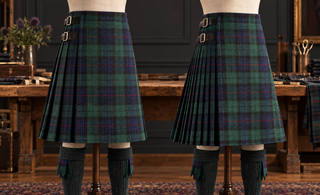
Choosing between a 5-yard and an 8-yard kilt is one of the most important decisions a first-time buyer makes. Both can look traditional from the front, both can be tailored to the same measurements, and both can be worn with a jacket, sporran and Highland accessories. The difference becomes clearer at the back: an 8-yard kilt normally carries more cloth in deeper or more numerous pleats, while a 5-yard kilt uses less material for a lighter, simpler drape.
That extra cloth changes the weight, movement, warmth, price and overall presence of the garment. It does not automatically make one choice correct for everyone.
Quick answer: Choose a 5-yard kilt if you want lighter weight, easier all-day wear, better comfort in warm weather and a more accessible price. Choose an 8-yard kilt if you want a fuller traditional silhouette, deeper pleats, more swing and a substantial feel for formal or ceremonial use.
Browse the verified men’s tartan kilt collection while you compare the details below.
What does “5 yard” or “8 yard” mean in a kilt?
The yardage refers to the approximate length of cloth used across the kilt before that cloth is shaped into the flat front aprons and the pleated back. In simple terms, an 8-yard kilt places more tartan into the pleats than a 5-yard kilt.
The number is a useful category, not a promise that every finished garment contains exactly the same amount of fabric. A tailor may need to adjust the cloth used according to:
- The wearer’s waist and seat measurements
- The width of the tartan sett
- Whether the kilt is pleated to sett or pleated to stripe
- The desired pleat width and depth
- The fabric width and construction method
- Any style-specific design requirements
This is why two 8-yard kilts can differ slightly in pleat count or finished weight. Yardage describes the overall construction class; the individual specification describes the actual garment.
5-yard vs 8-yard kilt: quick comparison
| Feature | 5-yard kilt | 8-yard kilt |
|---|---|---|
| Cloth volume | Lower | Higher |
| Finished weight | Usually lighter | Usually heavier |
| Pleat structure | Fewer, wider or shallower pleats | More numerous or deeper pleats |
| Movement | Controlled, lighter swing | Fuller swing and stronger visual movement |
| Warmth | Generally cooler | Generally warmer |
| Comfort | Easy for long wear and warmer climates | Substantial and secure when correctly fitted |
| Price | Usually lower | Usually higher |
| Best use | Casual wear, festivals, travel, warm weather, first kilt | Weddings, formal events, ceremonies, pipe bands, heritage wear |
| Appearance from front | Often very similar | Often very similar |
| Appearance from back | Cleaner and less full | Denser, fuller pleating |
How a 5-yard kilt looks and feels
A 5-yard kilt keeps the traditional wrapped front and pleated back while reducing the volume of material. The finished garment is usually lighter and easier to carry through a long day. Depending on how it is tailored, the pleats may be slightly wider, shallower or fewer in number than those on an 8-yard kilt.
The lighter construction is useful when you will be:
- Walking or standing for many hours
- Travelling with limited luggage
- Attending summer Highland games or outdoor festivals
- Dancing at a ceilidh
- Wearing a kilt regularly in a warmer climate
- Buying a first traditional-style kilt on a controlled budget
For US customers seeking a ready-stock lightweight example, the active Men’s Scottish Traditional 5-Yard 13oz Tartan Kilt provides a useful reference point. Check its current size, tartan and shipping options on the live product page.
A 5-yard kilt should not be confused with a poorly made costume kilt. Yardage alone does not determine quality. Accurate measurements, clean pattern matching, secure straps, proper apron overlap, stable internal construction and well-pressed pleats still matter.
How an 8-yard kilt looks and feels
An 8-yard kilt places more fabric into the pleated section. That additional material creates a fuller back, a more substantial hang and a stronger swing as the wearer walks or turns. It is the construction many buyers associate with formal traditional Highland dress.
An 8-yard kilt is often preferred for:
- Weddings and formal dinners
- Burns Night and Hogmanay events
- Clan gatherings and ceremonial occasions
- Pipe bands or group presentation
- Frequent wear where a full traditional appearance is the priority
- A long-term Highland outfit built around premium visual presence
The active Scottish Traditional Rose Ancient 8-Yard 16oz Tartan Kilt, available with multiple tartan options, illustrates the heavier, fuller category. Live options and availability can change, so review the current product details before ordering.
The extra cloth makes an 8-yard kilt heavier, but a correct fit distributes that weight around the waist and hips. If the kilt is measured too low, too loose or too long, the added weight can feel less secure. Fit remains more important than the yardage label.
The biggest visual difference: pleats
From the front, a 5-yard and an 8-yard kilt in the same tartan may look almost identical. Each presents a flat front apron and the tartan pattern as the dominant visual element. The difference appears when you turn around.
A 5-yard kilt has less cloth available for folding. The tailor may create fewer pleats, reduce their depth or make each pleat slightly wider. This produces a neat traditional outline with less bulk.
An 8-yard kilt allows deeper and denser pleating. The folds can remain closed while standing and open with more visual drama during movement. This is the source of the classic “swing” associated with a full traditional kilt.
Pleat quality is not measured only by quantity. Look for:
- Straight, even pleat edges
- Consistent pleat width
- Clean alignment of the chosen tartan feature
- Stable stitching through the fell
- Pleats that return to shape after movement
- A back line that hangs evenly at the hem
Pleated to sett vs pleated to stripe
Yardage and pleating style are related but different choices.
Pleated to sett attempts to repeat the main tartan pattern across the pleated back. When the wearer stands still, the back can resemble a continuation of the full sett. This approach may require careful planning and can use the available fabric differently according to the size of the tartan repeat.
Pleated to stripe selects a vertical line or color feature and centers it on each pleat. The back creates a rhythmic stripe effect. It is popular for military, band and highly defined visual presentation.
An 8-yard construction gives the tailor more cloth to create deep pleats in either style. A 5-yard kilt can also be carefully pleated, but the reduced fabric creates different limits. Ask what pleating method the product uses instead of assuming yardage answers the question.
Weight: yardage and fabric weight are not the same thing
Buyers often mix up two separate specifications:
- Yardage tells you approximately how much cloth is used.
- Fabric weight describes how heavy the cloth itself is, commonly stated in ounces.
An 8-yard kilt made with 13oz cloth uses more fabric but each piece of cloth is lighter than 16oz fabric. A 5-yard kilt made from 16oz cloth can feel firm and substantial even though it uses less total material.
To estimate comfort, consider both numbers together:
| Construction | Likely feel | Typical advantage |
|---|---|---|
| 5 yard + lighter cloth | Lightest and coolest | Warm climates, travel, long casual days |
| 5 yard + heavier cloth | Compact but structured | Crisp shape without maximum bulk |
| 8 yard + lighter cloth | Full pleats with moderated weight | Traditional look with easier movement |
| 8 yard + heavier cloth | Fullest and most substantial | Formal presence, cooler weather, ceremony |
Material also matters. Wool, acrylic wool, poly-viscose and other tartan fabrics can behave differently even when their listed weight is similar. Check the product’s actual composition, care instructions and construction.
Which kilt has the better swing?
An 8-yard kilt usually creates a fuller swing because more material is folded into the back. When the wearer walks, turns or dances, the pleats open and settle with greater depth. The effect is especially visible in heavyweight fabric.
A 5-yard kilt still moves, but the motion is lighter and more controlled. Some wearers prefer this for everyday use because there is less fabric to manage in crowds, vehicles or warm environments.
More swing is not automatically more comfortable. If you plan to dance, consider the combined weight of the kilt, jacket, sporran and footwear. A lighter outfit may keep you comfortable longer, while a fuller 8-yard kilt creates the strongest traditional presentation.
Which kilt is warmer?
All other specifications being equal, an 8-yard kilt is normally warmer because the pleated back contains more layers of cloth. That is useful for autumn and winter events, but it can become hot at summer festivals or active indoor ceilidhs.
A 5-yard kilt allows more ventilation and reduces the amount of material around the hips and seat. It is often the easier choice in hot weather or for people who naturally run warm.
Do not use climate alone to choose. A lighter fabric 8-yard kilt may remain comfortable, while a heavyweight 5-yard kilt can still feel warm. Consider yardage, fabric weight and the rest of the outfit together.
Is an 8-yard kilt more formal?
An 8-yard kilt is widely associated with full traditional and formal Highland dress because of its dense pleats, substantial hang and visual movement. For a wedding, gala, ceremony or formal portrait, it is the conventional premium choice.
However, a 5-yard kilt can still be worn smartly. With accurate tailoring, a formal jacket, dress sporran, hose and polished brogues, it can create a refined outfit—especially when lighter weight improves comfort.
Formality comes from the complete ensemble, not yardage alone. The jacket, shirt, tie, sporran, hose, footwear, tartan and quality of fit all contribute. Explore the complete kilt outfit collection to see how the core garment works with coordinated pieces.
5-yard vs 8-yard kilt price
A 5-yard kilt usually costs less because it uses less fabric and may require less pleating work. An 8-yard kilt typically costs more because it includes additional cloth and denser tailoring.
The final price can also change with:
- Tartan availability and special weaving
- Fabric composition and weight
- Standard sizing vs made-to-measure construction
- Pleating method
- Straps, buckles, lining and internal reinforcement
- Rush production or delivery
- Included accessories or outfit components
For a broader breakdown, read How Much Does a Kilt Cost in 2026? Compare the live product specification, not just the lowest displayed number.
Does more yardage mean a more durable kilt?
Not necessarily. Extra cloth can support deep pleats and a substantial garment, but durability depends on fabric quality, tailoring, stress points, fastening hardware, internal construction and care.
A well-made 5-yard kilt can outlast a poorly constructed 8-yard kilt. Inspect or ask about:
- Reinforcement at straps and buckles
- Stitching through the pleated fell
- Apron overlap and edge finishing
- Lining and stabilizing structure
- How the tartan should be cleaned and pressed
If the kilt is intended for frequent outdoor wear, a lighter garment may experience less strain simply because it is easier to move and sit in. If it is intended for ceremonial wear, the fuller construction may be worth the additional care.
Which is better for a first kilt?
For many first-time buyers, a 5-yard kilt is an approachable starting point. It costs less, travels easily and feels less demanding during long wear. It is especially sensible if you are still learning which tartans, jackets and accessories suit your lifestyle.
Choose an 8-yard kilt as your first kilt when you already know that you want the full traditional appearance, expect to attend formal events, or want one principal Highland outfit rather than several casual options.
Ask yourself:
- Where will I wear the kilt most often?
- Do I prioritize lightness or visual fullness?
- Will I wear it mainly in warm or cool conditions?
- How much walking or dancing will I do?
- Is this an occasional garment or a long-term formal outfit?
- What is my complete budget, including accessories?
Which yardage is better for different occasions?
Wedding
An 8-yard kilt is the classic choice for the groom, close family or a highly formal guest outfit. A 5-yard kilt can work for a relaxed summer wedding or when comfort and budget are stronger priorities.
Highland games and festivals
A 5-yard kilt is often easier for walking, travel and warm outdoor conditions. Choose 8 yards if traditional presentation or group uniformity matters more.
Ceilidh
Both work. Five yards reduces weight during long periods of dancing; eight yards provides the most dramatic movement. Secure fit and comfortable shoes matter more than the label.
Burns Night or Hogmanay
An 8-yard kilt suits a formal dinner, while a 5-yard kilt can be ideal for a lively pub, house party or warmer indoor venue.
Everyday wear
Five yards is generally easier for commuting, sitting, travel and repeated casual use.
Pipe band or ceremonial group
Follow the organization’s uniform specification. Consistent tartan, pleating and construction are more important than individual preference.
Does body size change the choice?
Both styles can be tailored for a wide range of body types. A larger waist may require more cloth than the category name suggests, while the pleat proportions may be adjusted to create a balanced appearance.
An 8-yard kilt can produce excellent drape and stability across a fuller seat, but the extra weight must be supported by accurate waist placement. A 5-yard kilt reduces bulk and can feel more comfortable for wearers who prefer a cleaner outline.
Do not select yardage as a substitute for measuring. Record the kilt waist, seat or hips, required length and height according to the product instructions. Follow the verified kilt measuring guide before placing a custom order.
Common myths about 5-yard and 8-yard kilts
Myth: A 5-yard kilt is not a real kilt
A properly constructed 5-yard kilt retains the essential wrapped apron and pleated-back design. It is a lighter construction, not automatically a costume.
Myth: Every 8-yard kilt has the same number of pleats
Pleat count changes with waist size, tartan sett, pleat style and tailoring decisions. Yardage does not guarantee one universal count.
Myth: An 8-yard kilt is always warmer than every 5-yard kilt
Usually it contains more layers, but fabric weight and composition also matter. A heavyweight 5-yard kilt may feel warmer than a lightweight 8-yard option in some conditions.
Myth: More fabric always means better quality
Quality depends on materials, fit, construction and finishing. Extra yardage improves fullness; it does not correct weak tailoring.
Myth: You need different measurements for 5 and 8 yards
The body measurements are taken from the same wearing position. The tailor changes the pleat construction, not your actual waist, hips or desired length.
How to choose: a simple decision guide
Choose a 5-yard kilt if most of these describe you:
- You want a lighter garment
- You live in or travel to a warm climate
- You expect long days of walking or dancing
- You want an affordable first kilt
- You prefer a streamlined back
- You need easier packing and travel
- Your events are mostly casual or semi-formal
Choose an 8-yard kilt if most of these describe you:
- You want the fullest traditional silhouette
- Deep pleats and strong swing are priorities
- You attend formal, ceremonial or heritage events
- You prefer a substantial garment
- You wear kilts mainly in cooler conditions
- You are building one principal Highland outfit
- You value visual presence more than minimum weight
Care differences
An 8-yard kilt takes more space to hang, store and press because it has denser pleating. Support it on a strong kilt hanger and let it air after wear. Do not crush the pleats into a small bag for long-term storage.
A 5-yard kilt is easier to pack, but its pleats still need correct folding. Follow the fabric’s specific cleaning instructions. Do not assume a tartan kilt is machine washable; material composition determines the correct method.
When travelling, fold the aprons flat, align the pleats and use a garment bag when possible. On arrival, hang the kilt promptly. A garment steamer may help with minor creasing only when the fabric care instructions permit it.
Frequently asked questions
Is a 5-yard kilt lighter than an 8-yard kilt?
Usually, yes, when both use the same fabric. The 5-yard construction contains less cloth. Fabric weight and material can still change the final comparison.
Can you wear a 5-yard kilt to a wedding?
Yes. A well-tailored 5-yard kilt can suit a wedding, especially in warm weather or a less formal setting. An 8-yard kilt offers a fuller traditional presentation for highly formal occasions.
Does an 8-yard kilt have more pleats?
It generally has more numerous or deeper pleats because more cloth is available. The exact count depends on the wearer’s size, tartan sett and tailoring method.
Which kilt is best for summer?
A 5-yard kilt in a lighter fabric is usually the coolest choice. Consider the complete outfit, venue and activity level as well.
Which kilt is best for dancing?
A 5-yard kilt reduces weight; an 8-yard kilt creates more dramatic swing. Choose based on comfort, fit and the visual effect you want.
Is an 8-yard kilt worth the extra cost?
It is worth considering when deep pleats, traditional fullness, formal presentation and long-term use matter to you. If lightness and price are stronger priorities, a 5-yard kilt may provide better value.
Can I own both?
Yes. Many wearers use a lighter 5-yard kilt for casual events and travel, then keep an 8-yard kilt for weddings, ceremonies and formal Highland dress.
Final verdict
There is no universal winner in the 5-yard vs 8-yard kilt debate. The 5-yard kilt is lighter, cooler, easier to travel with and usually more affordable. The 8-yard kilt delivers denser pleats, fuller movement and the most substantial traditional appearance.
Choose according to where you will wear it, how much weight you enjoy, the climate, your budget and the level of formality. Then confirm the fabric, pleating, measurements and included features on the actual product page.
Explore the complete Kilt Experts kilt collection and compare live options before ordering. A correctly measured 5-yard or 8-yard kilt will always serve you better than the wrong yardage in the wrong size.