
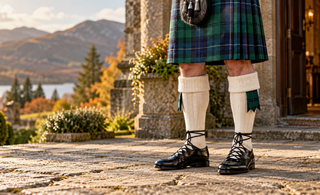
Kilt socks and flashes may look like small details, but they have a major effect on the balance of a Highland outfit. Socks worn too high can crowd the knee, a loose cuff can slide during an event, and flashes placed at the front can make an otherwise polished outfit look slightly wrong. Worn correctly, however, kilt hose frame the lower leg, connect the tartan to the footwear and add a controlled touch of colour.
This complete guide explains how to wear kilt socks and flashes, including the correct height, cuff fold, garter position, colour combinations, sizing, footwear and care. It also covers the differences between formal, wedding, casual and outdoor styling so you can choose the right combination rather than relying on one rule for every occasion.
Quick answer: pull the kilt hose up to just below the knee, fasten the flash garter securely around the upper calf, position the decorative tabs on the outside of the leg, then fold the sock cuff down to cover the elastic while leaving the flashes visible. The two legs should look even, and a small area of bare knee should remain between the kilt hem and the hose.
Start by comparing our kilt hose and socks and flashes and fly plaids, then use the steps below to build a comfortable, well-proportioned look.
What Are Kilt Socks?
Kilt socks, also called kilt hose, are long socks designed to be worn with a kilt. They usually reach above the calf and include enough extra length at the top to create a turned-down cuff. Traditional styles may be ribbed, cable-knit or patterned around the cuff, while modern options range from lightweight blends to thicker wool-rich hose.
Their job is practical as well as visual. Kilt hose provide warmth, reduce friction inside shoes and help create the characteristic line between the kilt and footwear. The cuff also hides the elastic part of the flash garter, keeping the finished appearance neat.
Unlike ordinary knee-high socks, purpose-made kilt hose are shaped and proportioned for this fold. Trying to imitate the look with short everyday socks often produces a cuff that is too narrow, too thin or unable to cover the garter securely.
What Are Kilt Flashes?
Kilt flashes are decorative fabric tabs attached to an adjustable elastic or fastening band. The band wraps around the upper calf and helps hold the hose in place; the visible tabs hang below the folded cuff. Flashes may be made from the same tartan as the kilt, a coordinating tartan or a solid colour chosen from the sett.
They serve three useful purposes:
- Support: the garter helps stop the hose from slipping during walking, dancing or a long event.
- Colour: the tabs repeat or contrast with the tartan without adding another large patterned area.
- Finish: they provide the traditional transition between the folded cuff and the leg of the sock.
Our multi-tartan kilt hose flashes are designed to coordinate with a wide range of kilts and use an adjustable closure for a secure fit.
How to Wear Kilt Socks and Flashes: Step by Step
Step 1: Put on the hose before the kilt if convenient
You can put the hose on before or after the kilt, but doing it first is often easier because you can see both legs clearly and adjust the fabric without bending over in a fully dressed outfit. Make sure the heel sits correctly, the toe is smooth and the knit is not twisted around the calf.
Step 2: Pull each sock fully up
Pull the hose above the point where you want the finished cuff to sit. Do not create the fold yet. Smooth the fabric from the ankle upward so there are no uncomfortable ridges inside the shoe or behind the calf.
Step 3: Position the top below the knee
The finished hose should sit just below the knee rather than directly on the kneecap. Leave enough space for the knee to bend freely and for a visible strip of skin between the sock and kilt hem. The exact distance varies with leg length, kilt length and cuff depth, so use overall proportion rather than forcing every wearer into one measurement.
Step 4: Fasten the flash garter
Wrap the elastic band around the upper calf, below the knee and above the widest point of the calf where possible. It should be snug enough to stay in place but not so tight that it causes pain, deep marks, numbness or tingling. If the band feels restrictive while sitting, loosen it before continuing.
Step 5: Turn the flash tabs toward the outside
Position the visible flashes on the outside of each leg. They should not point straight forward over the shin or disappear behind the calf. When viewed from the front, a controlled part of each flash should be visible beyond the outer edge of the leg.
Step 6: Fold the cuff down over the garter
Fold the top of the sock down evenly to hide the elastic band while leaving the decorative tabs visible. A cuff of roughly three to four inches is common, but the correct depth depends on the hose design and your proportions. Keep the lower edge level all the way around rather than rolling it into a thick rope.
Step 7: Match both legs
Stand in front of a full-length mirror and compare the height, cuff depth and flash angle. Small differences are much more noticeable in photographs than they feel while dressing. Adjust now, before adding shoes and other accessories.
Step 8: Put on the shoes and test movement
Walk, sit, bend the knee and take a few stairs. The hose should stay smooth at the ankle, the garters should remain comfortable and the flashes should not rotate toward the front. If your shoes have long laces, tie them so they are secure without compressing the calf.
How High Should Kilt Socks Be?
The upper edge of the folded cuff normally sits below the kneecap, not on it. Wearing hose too high can make the leg look shortened and may cause the cuff to rub when the knee bends. Wearing them too low leaves too much bare leg and can make the socks look like ordinary hiking socks.
Use these visual checks:
- The kneecap should be free to move.
- A visible gap should remain between the kilt hem and the top of the hose.
- The exposed skin should look similar on both legs.
- The cuff should not collide with the lower edge of the kilt when standing.
- The sock should remain high enough that its traditional length is obvious.
If the kilt itself sits too low or is longer than intended, adjusting the hose cannot fully correct the proportion. Check the kilt fit separately using our kilt measuring guide.
How Much Flash Should Show?
The coloured tabs should be clearly visible below the cuff without dominating the leg. In most designs, an inch or two of fabric creates a balanced result, although longer or wider flashes may naturally show more. The important details are consistency and placement: the same amount should appear on both legs, and both sets should sit at a similar angle.
If very little fabric shows, the cuff may be folded too deeply or the garter may be set too high. If the entire flash hangs down the calf, the cuff may be too shallow or the garter too low. Make small adjustments while standing naturally rather than pulling hard on the tabs.
Choosing the Right Kilt Hose Colour
There is no single sock colour that works with every kilt. The best choice depends on the tartan, jacket, footwear, formality and setting.
| Hose colour | Best use | Styling effect |
|---|---|---|
| Cream or off-white | Weddings, formal Highland dress, traditional outfits | Classic, bright and high contrast |
| Black | Evening wear, dark jackets, modern outfits | Clean, sharp and easy to coordinate |
| Charcoal or grey | Tweed, daywear, muted tartans | Soft, versatile and understated |
| Lovat green or blue | Country wear, day jackets, outdoor events | Traditional colour with less contrast |
| Bold colour | Festivals, contemporary styling, team or clan colour | Expressive; needs careful coordination |
Cream hose are a familiar choice for formal outfits, but they are not compulsory for every wedding. Grey, black or muted green can look more refined with darker tartans and tweed jackets. For casual wear, coloured hose may pick up one minor stripe in the tartan without matching its dominant colour exactly.
If you need a versatile traditional option, the USA-stock wool-blend kilt hose offer classic colours and multiple sizes. European customers can also check the EU-stock kilt hose.
Should Flashes Match the Kilt?
Matching tartan flashes are traditional and visually satisfying, especially for a wedding party or coordinated outfit. They are not the only correct option. Solid-colour flashes can be easier to style and may prevent a busy tartan from becoming overwhelming.
Use one of these approaches:
- Exact match: wear flashes cut from the same tartan as the kilt for a formal, coordinated result.
- Colour echo: choose a solid colour found in the tartan, such as navy, green, red or burgundy.
- Neutral contrast: pair black or dark flashes with cream hose and a dark jacket.
- Personal connection: use a second tartan or symbolic colour when it has meaning, while keeping the rest of the outfit restrained.
A useful rule is to repeat, not compete. If the tartan is already bright and complex, flashes in one controlled colour often look more polished than adding another busy pattern.
Best Kilt Socks and Flashes for Different Occasions
Formal wedding or black-tie Highland dress
Choose well-shaped hose with a crisp cuff and understated flashes. Cream, off-white, black or a refined dark shade works well depending on the tartan and jacket. Match the level of polish to a full-dress sporran and formal footwear. Our sporran selection guide can help keep the accessories at the same level of formality.
Day wedding or smart daytime event
Grey, lovat green, lovat blue or cream hose can all work. Tartan flashes or a solid colour drawn from the kilt add interest without making the outfit too ceremonial. Pair with an Argyll-style jacket, waistcoat or smart tweed.
Highland games and festivals
Prioritise comfort, secure garters and a blend suited to the weather. Darker hose hide marks better during a long outdoor day. Check the cuff after extended walking, and carry a spare pair if the event may be wet.
Casual kilt outfits
You can relax the traditional formula. Chunkier hose with boots, darker neutral socks or a lower-key fold can suit a sweater, polo or casual jacket. Flashes are optional for a deliberately modern outfit, but if you use them, keep both sides even.
Pipe bands and organised uniforms
Follow the organisation's dress regulations. Sock colour, pattern, flash position and footwear may be standardised. Uniform consistency takes priority over personal colour preference.
Matching Kilt Hose With Shoes
The socks create the visual bridge between the kilt and shoes, so the footwear matters.
- Ghillie brogues: traditional with formal or ceremonial outfits. Keep the hose smooth so the laces sit comfortably.
- Day brogues: a versatile choice for weddings, work events and smart daywear.
- Boots: practical with utility kilts, outdoor wear and casual tartan outfits. Choose thicker hose if the boot has extra internal volume.
- Contemporary shoes: loafers, plain leather shoes or clean trainers can work with intentionally modern kilt styling, but flashes may make a very casual shoe feel disconnected.
For more detailed footwear combinations, see the best shoes to wear with a kilt.
How to Choose the Correct Kilt Sock Size
Start with the manufacturer's shoe-size chart, then consider calf circumference and leg length. Two people with the same shoe size can need a different fit because the upper sock must stretch comfortably around the calf and still provide enough length for the fold.
Look for these signs of correct fit:
- The heel pocket aligns with your heel.
- The toe lies flat without bunching.
- The sock reaches high enough to form the intended cuff.
- The calf is supported but not compressed.
- The fabric does not become transparent when stretched.
- The hose stays smooth inside the shoe.
If you have a broad calf, do not simply size down to make the sock tighter. That can overstretch the knit and make the garter uncomfortable. Choose a size and material blend that accommodates the calf, then use the adjustable flashes for gentle support.
Comfort Tips for Long Weddings and Events
Dress for the full day, not just the first photograph. Test the complete outfit at home for at least 20 to 30 minutes. Walk on stairs, sit at a table and bend the knees. If the garter leaves a deep mark or causes tingling, it is too tight.
In warm conditions, choose breathable hose and change into a fresh pair if needed. In cold weather, a wool-rich blend offers useful insulation, but footwear must still have enough room for the thicker sock. Trapped toes and pressure points become more uncomfortable as the day continues.
Keep a small emergency kit with blister plasters, a spare garter or safety pin, and an extra pair of socks when travelling to an important event. Do not pin flashes directly through quality hose unless the product is designed for it, because the pin can damage the knit.
Can You Wear a Sgian-Dubh in the Kilt Hose?
Traditionally, a sgian-dubh may be placed in the top of the hose with only the handle visible. It is commonly worn on the same side as the dominant hand, although customs and uniform rules can vary.
Always check venue rules, local laws, airline restrictions and event security policies before carrying any blade, even as part of traditional dress. For many modern events, a bladeless decorative alternative is the safer choice. The item should never be allowed to press uncomfortably against the leg or distort the cuff.
Common Kilt Hose and Flash Mistakes
- Wearing the socks over the kneecap: this restricts movement and ruins the traditional gap below the kilt.
- Placing flashes at the front: the tabs should sit toward the outside of each leg.
- Uneven cuff depth: one high cuff is obvious in full-length photographs.
- Overtightening the garter: support should never cause numbness, pain or deep pressure marks.
- Using too many colours: tartan, tie, flashes and hose should share a plan rather than compete.
- Ignoring the shoes: thin dress hose in loose boots or bulky socks in tight brogues can create discomfort.
- Rolling instead of folding: a thick rolled band looks untidy and may press into the calf.
- Skipping the movement test: an outfit that looks correct while standing may slip as soon as you walk or dance.
How to Wash and Store Kilt Hose and Flashes
Read the care label first because wool-rich, acrylic and blended hose may require different treatment. In general, wash gently at a cool temperature with a mild detergent, avoid aggressive wringing and reshape the socks while damp. Dry flat away from direct heat to reduce shrinking and distortion.
Remove flashes before washing. Wipe or hand-clean them according to their fabric and fastening type, then lay them flat so the tabs keep their shape. Store hose clean and completely dry. Folding them loosely is better than stretching the cuffs around other items.
Before a formal event, inspect the heels and toes for thinning, check that the garter elastic still recovers and make sure both flash tabs hang evenly. Replacing worn accessories before the event is easier than trying to repair them while dressing.
Frequently Asked Questions
Are kilt socks the same as kilt hose?
Yes. The terms are commonly used interchangeably for long socks designed to be folded below the knee and worn with Highland dress.
Do you have to wear flashes with kilt socks?
Not for every modern or casual outfit, but flashes help hold the hose and create the traditional finished look. They are strongly recommended for formal Highland dress.
Where should kilt flashes sit?
The visible tabs should sit on the outside of each leg beneath the folded cuff, not directly over the shin or at the back of the calf.
How far below the knee should kilt socks sit?
They should clear the kneecap and allow comfortable bending. The exact distance depends on your leg length, cuff depth and kilt length, so match the proportions of both legs rather than relying on one rigid measurement.
Can I wear black socks with any tartan?
Black is versatile, especially with black shoes and an evening jacket. With a very light or warm-toned tartan, grey, cream or brown-toned hose may create a softer balance.
Should wedding-party flashes match?
Matching flashes produce a consistent formal look and make group photographs feel coordinated. If exact tartan flashes are unavailable, one shared solid colour from the tartan is an effective alternative.
Can women wear kilt hose and flashes?
Yes. Choose the style according to the kilt, footwear and occasion. The same principles of comfort, even cuff height and outside flash placement apply.
Can I wear kilt socks with boots?
Yes. Boots work well for casual, outdoor and utility-kilt outfits. Make sure the sock thickness suits the boot and that no heavy folds collect around the ankle.
Final Dressing Checklist
- Choose hose that fit the shoe size and calf comfortably.
- Pull the socks smooth before fastening the garters.
- Set each garter securely below the knee without overtightening.
- Turn the flash tabs to the outside of the legs.
- Fold both cuffs to the same depth and hide the elastic.
- Keep a balanced gap between the kilt hem and hose.
- Match hose, flashes, shoes and jacket to the same level of formality.
- Walk, sit and bend before leaving for the event.
Kilt hose and flashes are easy to wear once the sequence is clear: smooth, secure, position, fold and compare. The best result is not the most complicated one; it is the combination that remains comfortable, symmetrical and appropriate from the ceremony to the final photograph.
Shop the Kilt Experts kilt hose collection, browse tartan kilt flashes, or explore all kilt accessories to complete your Highland outfit.