
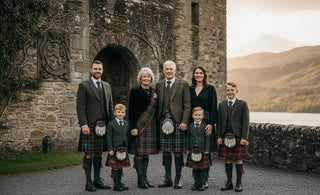
When a family gathers in tartan, something enters the room that cannot be invited by words alone. It is not nostalgia, and it is not performance. It is presence. The kind that settles quietly, changes the temperature of the moment, and reminds everyone there that they are not standing alone in time. History arrives not as a distant subject but as a companion—steady, observant, and deeply familiar.
In such moments, the past does not interrupt the present. It joins it. The tartan does not demand attention; it offers continuity. It brings together people who may differ in age, outlook, and experience and places them within the same long story. This is why gatherings marked by tartan feel different from other family occasions. There is a depth beneath the surface, a sense that more is happening than what can be immediately seen.
A family gathering is often about reunion, celebration, or remembrance. When tartan is present, these meanings expand. The gathering becomes layered. It acknowledges not only who is present now, but who once stood in similar rooms, on similar ground, carrying similar hopes and responsibilities. History does not hover abstractly. It stands with them, visible in cloth, pattern, and shared recognition.
Tartan as the Language of Continuity
Families are built on continuity, even when they are marked by change. Names evolve. Homes move. Traditions adapt. But certain elements persist, and tartan is one of the most enduring among them. When a family gathers in tartan, they speak a shared language without speaking at all.
This language is not learned in classrooms. It is learned through repetition and observation. Children see parents and grandparents treat the tartan with care. They notice that it appears at moments that matter. Over time, the tartan becomes associated with significance rather than spectacle.
In a gathering, this shared understanding becomes visible. The tartan does not explain itself, yet everyone present understands that it represents more than individual taste. It represents continuity—proof that the family’s story did not begin with those in the room and will not end with them either.
The Way Tartan Changes the Atmosphere of a Gathering
There is a subtle shift that occurs when tartan enters a family gathering. Conversations slow slightly. Movements become more deliberate. People seem more aware of one another. This is not because the tartan demands solemnity, but because it invites awareness.
Tartan carries weight—not heaviness, but gravity. It reminds people that what they are sharing is not just a meal, a celebration, or a moment of remembrance. It is part of a longer rhythm. That awareness alters behaviour gently, without instruction.
People listen more closely. They speak with greater care. They become conscious of how their actions fit into the moment. The tartan acts as a quiet anchor, grounding the gathering in something larger than the present.
History Made Tangible Through Fabric
History often feels distant because it lacks physical presence. Dates and names alone cannot convey the lived experience of those who came before. Tartan changes this. It brings history into the room in a form that can be seen, touched, and worn.
When multiple generations gather wearing the same tartan, history becomes tangible. The same pattern that once moved with an ancestor’s stride now moves with a descendant’s. The continuity is not symbolic—it is physical.
This tangibility bridges the gap between memory and reality. History is no longer something spoken about; it is something shared. The tartan allows people to feel connected to those they may never have met, grounding abstract lineage in lived experience.
The Role of Elders in Tartan Gatherings
Elders often carry the deepest connection to tartan within a family. Their relationship with it has been shaped by years of experience, memory, and responsibility. When they gather in tartan with younger generations, their presence carries authority without assertion.
The way an elder wears tartan communicates volumes. Their posture, restraint, and familiarity with the garment speak of a lifetime lived alongside tradition. Younger family members observe this instinctively. They learn without being taught.
In these moments, history does not need to be narrated. It is embodied. The elder becomes a living link, and the tartan becomes the visible thread connecting past to present.
Children and the First Awareness of Belonging
For children, a family gathering in tartan often marks their first conscious encounter with heritage. They may not understand clan systems or historical context, but they sense that the moment is important.
They notice that adults behave differently. That certain garments are handled carefully. That stories are told more often. That emotions run deeper. This awareness settles quietly within them, shaping their understanding of belonging long before they can articulate it.
Later in life, when these children encounter tartan again—perhaps wearing it themselves for the first time—the memory resurfaces. The feeling is familiar. The connection is already formed. History stands with them because it has always been there, quietly present.
When Tartan Marks Celebration
Celebrations take on a different quality when tartan is present. Weddings, anniversaries, and reunions become more than milestones; they become affirmations of continuity.
In these moments, tartan acknowledges that joy does not exist in isolation. It grows from the labour, sacrifice, and endurance of those who came before. Wearing tartan during celebration is a way of honouring that foundation without diminishing the happiness of the present.
Laughter feels fuller. Smiles feel steadier. The gathering becomes a meeting point between past achievement and future hope. History stands with the family not as a shadow, but as support.
When Tartan Holds Space for Grief
Grief is one of the moments when history’s presence is felt most strongly. At funerals or memorial gatherings, tartan provides a language for loss that words cannot adequately express.
When a family gathers in tartan during mourning, the garment absorbs emotion. It allows people to stand together in silence, supported by shared identity. The tartan does not explain grief; it holds it.
In these moments, history stands with the family as reassurance. It reminds them that others have endured loss and continued forward. The continuity embodied in the tartan offers comfort without false optimism.
Shared Recognition Without Conversation
One of the most powerful aspects of a tartan gathering is the recognition that occurs without conversation. A glance between two relatives. A nod between generations. A shared moment of stillness.
These exchanges require no explanation because the tartan has already communicated what needs to be known. Everyone present understands that they are part of the same extended story, regardless of differences in experience or belief.
This unspoken recognition strengthens family bonds. It creates a sense of unity that does not depend on agreement or similarity. History stands with them as common ground.
Tartan as a Witness to Family Change
Families are not static. They change through marriage, loss, migration, and time. When a family gathers in tartan repeatedly across years, the garment becomes a witness to these changes.
It sees who is missing. It sees who has arrived. It sees relationships evolve. The tartan does not judge or resist these changes. It simply remains present, offering continuity amid transformation.
This presence helps families navigate change with greater resilience. It reassures them that while circumstances shift, identity endures. History stands with them not as resistance to change, but as stability within it.
The Responsibility Felt by the Wearer
Wearing tartan at a family gathering carries responsibility. Not obligation, but awareness. The wearer understands that they represent more than themselves. They represent lineage, shared values, and collective memory.
This awareness influences behaviour. People act with care. They become more attentive to their actions and words. The tartan quietly encourages dignity and restraint.
This responsibility does not feel heavy. It feels grounding. It reminds the wearer that they are part of something larger, something worth respecting. History stands with them as a guide rather than a burden.
When Distance Is Overcome by Tartan
In families spread across regions or continents, tartan becomes a powerful unifier. When relatives who live far apart gather wearing the same tartan, distance collapses.
The shared pattern bridges years of separation. It provides immediate recognition and connection. Even those meeting for the first time feel linked by something tangible and familiar.
In these moments, history stands with the family as proof that separation does not erase belonging. The tartan carries continuity across geography as easily as across time.
Tartan and the Sense of Place
Even when gatherings take place far from the Highlands, tartan carries a sense of place with it. The colours evoke landscapes. The patterns recall origins. The fabric brings the land into the room.
This sense of place deepens the gathering. It reminds everyone present that their story is rooted somewhere specific, even if life has taken them elsewhere. History stands with them as geography remembered and honoured.
The tartan becomes a portable homeland, allowing families to gather with a sense of rootedness wherever they may be.
The Quiet Authority of Tradition
Tradition often struggles to maintain relevance when it demands attention. Tartan avoids this by exercising quiet authority. It does not insist on recognition. It earns it.
In a family gathering, this authority becomes evident. People instinctively adjust their behaviour. They recognize the significance of the moment without being told. The tartan commands respect through familiarity rather than enforcement.
This quiet authority is why history stands with the family so naturally. It does not need to announce itself. It is already understood.
Memory Preserved Without Precision
Families rarely remember their histories with perfect accuracy. Dates blur. Stories shift. Details are lost. Tartan does not require precision to remain meaningful.
It preserves memory emotionally rather than factually. It holds the essence of continuity even when specifics fade. This makes it resilient. It can unite generations even when knowledge gaps exist.
When a family gathers in tartan, history stands with them not as a list of facts, but as a shared feeling of origin and belonging.
Why These Gatherings Endure in Memory
Family gatherings marked by tartan tend to linger in memory. People recall them with clarity years later. Not always because of what was said or done, but because of how the moment felt.
The presence of tartan deepens emotional imprint. It signals significance. It tells the mind that this moment matters. As a result, the gathering becomes part of family lore.
History stands with them not only in the moment, but in memory long afterward.
Conclusion
When a family gathers in tartan, history does not stand behind them as something finished. It stands with them—present, supportive, and alive. The tartan brings continuity into the room, connecting generations through fabric, memory, and shared recognition.
It allows families to experience belonging without explanation, to honour the past without being trapped by it, and to move forward with a sense of grounded identity. In these gatherings, the kilt and tartan do what they have always done best: they hold people together across time.
History does not speak loudly in these moments.
It does not need to.
It is already there, standing among them.