
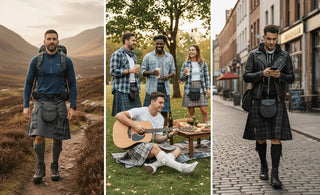
To many people encountering the kilt from the outside, it appears first as formalwear. It is seen at weddings, ceremonies, parades, and official gatherings. It is associated with dignity, structure, and tradition. While none of this is incorrect, it is incomplete. In Highland culture, and in Scottish life more broadly, the kilt has never existed solely as a formal garment. Its meaning runs deeper than occasion, deeper than etiquette, and far deeper than appearance.
The kilt is more than what is worn at important moments; it is part of how those moments come to matter. It does not merely dress the body for formality. It situates the person within a continuum of place, people, memory, and responsibility. Its formality is not its essence—it is simply one of the ways its deeper significance becomes visible.
Understanding why the kilt is more than formalwear requires stepping away from modern assumptions about clothing. It requires seeing the kilt not as an outfit selected for an event, but as a cultural object that has always existed in relationship to daily life, land, and identity. The kilt did not begin as a ceremonial costume. It became formal precisely because it was foundational.
Born From Function, Not Ceremony
The origins of the kilt lie in practicality, not pageantry. Early Highland life demanded clothing that could withstand weather, terrain, and constant movement. The kilt answered these needs. It allowed freedom of motion across uneven ground. It provided warmth in cold, wet conditions. It could be adjusted for work, rest, and travel.
This functional origin shaped the character of the garment. It was never fragile or decorative at its core. It was reliable. It was adaptable. It belonged to everyday life long before it belonged to ceremony.
This history matters because it explains why the kilt still carries a sense of groundedness even when worn formally. It does not feel like costume because it was not designed as one. Its formality is layered on top of a deeper practicality, and that practicality still resonates in how it is worn and perceived.
A Garment Shaped by Land and Life
The kilt is inseparable from the Highlands themselves. The landscape shaped its form, and the form shaped the way people moved through that landscape. Wind, rain, hills, and long distances all influenced how the kilt was worn and how it behaved on the body.
Because of this, the kilt carries with it a relationship to place that formal garments typically lack. It does not exist independently of environment. Even when worn indoors or far from Scotland, it carries echoes of the land that shaped it.
This connection to place gives the kilt depth beyond occasion. It is not worn simply to look appropriate for an event. It is worn to acknowledge a relationship—with land, with history, and with a way of life that valued adaptation and endurance.
Everyday Meaning Beneath Special Occasions
While modern life has shifted the kilt toward ceremonial use, its everyday meaning has not disappeared. Instead, it has become concentrated. When something is no longer worn daily, its appearances carry more weight.
In Highland and Scottish communities, the kilt still appears at moments that matter most. Weddings, funerals, gatherings, and commemorations are not chosen arbitrarily. They are moments when identity, continuity, and belonging are most visible.
The kilt’s presence at these moments is not about dressing up. It is about grounding the occasion. It connects the event to a longer story, reminding everyone present that the moment exists within a continuum of shared experience.
This is why the kilt feels different from other formal garments. It does not simply mark importance; it deepens it.
A Carrier of Identity, Not Status
Formal clothing in many cultures is often tied to status. It distinguishes roles, ranks, or economic position. The kilt operates differently. While it is worn with dignity, it does not primarily signal hierarchy.
In Highland society, the kilt historically crossed social boundaries. It was worn by people of varying means and roles. Its meaning came from belonging rather than position. This ethos continues today.
When someone wears a kilt, they are not elevating themselves above others. They are aligning themselves with a shared identity. The garment communicates connection rather than separation. This collective orientation sets it apart from many forms of formalwear.
The respect associated with the kilt comes not from exclusivity, but from shared understanding.
Responsibility Woven Into the Garment
Wearing a kilt carries responsibility that extends beyond etiquette. It involves representing family, heritage, and shared values. This responsibility is not enforced externally. It is understood internally.
People often notice that those wearing kilts tend to move and behave with a certain restraint. Posture changes. Awareness increases. Actions become more deliberate. This is not because of rules, but because the garment invites mindfulness.
This sense of responsibility is part of why the kilt feels weighty even when worn formally. It reminds the wearer that they are part of something larger than themselves. That awareness transforms the act of wearing into something more meaningful than dressing for an event.
A Nonverbal Form of Communication
The kilt communicates without speaking. It conveys respect, belonging, and continuity through presence alone. This silent communication is one of its most powerful qualities.
In gatherings where multiple generations are present, the kilt allows understanding to flow without explanation. Elders and younger people may not express themselves in the same ways, but the garment provides a shared language.
This ability to communicate silently is rare in formalwear. Most formal garments rely on visual cues of prestige or fashion. The kilt relies on recognition and shared cultural understanding.
Its meaning is not announced. It is perceived.
Memory Held in Cloth
Unlike most formal garments, kilts often carry personal and familial memory. They are worn repeatedly across years and generations. They appear in photographs, at milestones, and during moments of transition.
Over time, the fabric absorbs these experiences. Repairs, alterations, and wear patterns tell stories. Even when specific details are forgotten, the presence of the garment evokes familiarity.
This accumulation of memory distinguishes the kilt from clothing worn once and stored away. It becomes a living archive of family and community life. When worn formally, it brings those layers of memory into the moment.
The formality does not erase the past. It carries it forward.
A Bridge Between Generations
Formal garments are often tied to a particular era or fashion cycle. They date quickly. The kilt does not. Its form remains recognizable across centuries.
This stability allows the kilt to function as a bridge between generations. When a grandparent and grandchild wear kilts together, they participate in the same visual tradition despite differences in age and experience.
This shared participation creates unity. It allows generations to stand together without needing identical perspectives or lifestyles. The kilt provides common ground rooted in continuity rather than trend.
This generational function gives the kilt significance far beyond formality.
Adaptation Without Loss of Meaning
The kilt’s endurance is due in part to its adaptability. While its core form remains stable, its contexts of use have expanded. It is worn in rural and urban settings, in Scotland and abroad, in traditional and contemporary environments.
This adaptability ensures relevance. The kilt does not demand that life remain the same. It simply asks to remain meaningful.
Formalwear that cannot adapt often becomes obsolete. The kilt avoids this fate by remaining flexible in use while stable in identity. Its meaning deepens rather than diminishes with each adaptation.
The Emotional Dimension of Wearing a Kilt
Many people describe a shift in how they feel when wearing a kilt. There is a sense of grounding, of confidence, of alignment. This emotional response is not incidental.
The kilt carries emotional associations built over time. It is linked to important moments, family presence, and collective memory. Wearing it activates those associations.
This emotional dimension is what separates the kilt from purely formal garments. It does not simply make someone look appropriate; it makes them feel connected. That feeling influences posture, movement, and interaction.
The kilt supports the wearer from the inside as much as it represents them outwardly.
Why Formality Became One of Its Roles
The kilt did not start as formalwear. It became formal because it came to represent what mattered most. When societies formalize garments, they choose those that embody shared values.
The kilt was chosen because it already carried identity, continuity, and respect. Formality was added not to elevate it, but to acknowledge its significance.
This reversal is important. The kilt is not meaningful because it is formal. It is formal because it is meaningful.
Beyond Events, Into Identity
Ultimately, the kilt cannot be confined to events or dress codes. It lives within identity. It shapes how people understand themselves in relation to others, to history, and to place.
When someone wears a kilt, they are not simply meeting an expectation. They are participating in a living tradition that connects past, present, and future.
This participation is voluntary, personal, and deeply rooted. It cannot be reduced to formality alone.
Conclusion
The kilt is more than a formal garment because it was never meant to be only that. It began as practical clothing shaped by land and life. It evolved into a symbol of identity through shared experience and endurance. It became formal not through artificial elevation, but through accumulated meaning.
Today, when a kilt is worn formally, it brings with it layers of history, memory, responsibility, and belonging. It does not merely dress the body. It situates the wearer within a continuum that extends far beyond the occasion.
In a world where clothing often serves surface-level purpose, the kilt remains a rare example of something deeper—a garment that carries meaning whether it is worn in ceremony or silence.
That is why it endures.
That is why it matters.
And that is why it will always be more than formalwear.