
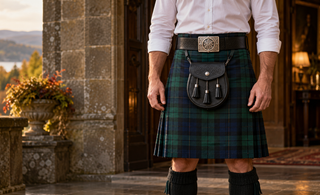
A kilt belt is one of the most visible finishing pieces in Highland dress. Worn correctly, it frames the front apron, gives the outfit a strong centre line and creates a clean transition between your shirt or jacket and the tartan. Worn too tight, too low or with the wrong formal combination, it can make an otherwise well-fitted kilt look uncomfortable or overcrowded.
The short answer: thread a purpose-made wide kilt belt through the kilt’s belt loops, fasten it at the natural waist, and centre the buckle above the front apron. The belt should feel secure without carrying the weight of the kilt. Position the sporran centrally below the buckle, and usually leave the belt off when wearing a fitted waistcoat.
This guide explains exactly how to wear a kilt belt and buckle, how to choose the right size, when a belt is appropriate, how to coordinate it with a sporran and other accessories, and which common mistakes to avoid.
What Is a Kilt Belt?
A traditional kilt belt is wider than an ordinary trouser belt. Most are made from substantial leather and accept a detachable decorative buckle. The extra width suits the scale of the kilt and helps the belt look balanced against pleats, tartan and a sporran.
A kilt belt is primarily a styling accessory. A properly fitted kilt should already sit securely at your natural waist without needing a belt to keep it up. If the kilt slips unless the belt is pulled very tight, the real issue is likely sizing or adjustment. Our kilt measuring guide explains where to take the waist, hip and length measurements before ordering.
For a coordinated starting point, browse the kilt belts and buckles collection, which includes wide leather belts and interchangeable buckle designs.
Kilt Belt vs Ordinary Trouser Belt
Both accessories wrap around the waist, but they are designed for different clothes and proportions.
| Feature | Kilt Belt | Trouser Belt |
|---|---|---|
| Width | Broad and visually substantial | Narrower, sized for trouser loops |
| Buckle | Often detachable and decorative | Usually permanently attached |
| Position | Natural waist, above the kilt apron | Lower trouser waist |
| Purpose | Highland-dress styling and proportion | Holding trousers and everyday styling |
A narrow everyday belt may physically fit some loops, but it usually looks undersized beside a kilt and sporran. A purpose-made kilt belt creates a cleaner, more intentional result.
How to Wear a Kilt Belt and Buckle: Step by Step
1. Put on and fasten the kilt first
Wrap and buckle the kilt at your natural waist. Smooth the front aprons so they lie flat, check that the pleats fall at the back, and confirm that the hem is level. The kilt should already feel secure before you add the belt.
2. Attach the buckle to the belt
Most kilt buckles are removable. Open the belt’s fastening tabs or press-stud section, pass the leather end through the buckle fitting, and close the tabs securely. Check that the decorative face is upright before putting the belt on. A symmetrical motif makes misalignment obvious, so take a moment to orient it correctly.
3. Set the belt to your waist size
Adjust the belt using its hook-and-loop section, holes or leather tab system. Start slightly loose; it is easier to tighten after the belt is in position than to force an overly tight belt around the kilt.
4. Thread it through the wide belt loops
Pass the belt through the kilt’s wide belt loops, normally working around the back and sides. Keep the leather flat and untwisted. Do not force the belt through smaller loops intended for sporran chains or straps.
5. Fasten and centre the buckle
Bring the buckle to the front and position it on the centre line of the front apron. It should sit at the natural waist, not sag toward the hips. Stand normally rather than pulling in your stomach; the belt needs to remain comfortable when you breathe, sit and move.
6. Add and align the sporran
Place the sporran centrally below the buckle. Its strap or chain should sit smoothly around the waist without bunching the shirt or trapping the belt. The exact drop depends on your height and the sporran design, but a practical starting point is roughly a hand’s width below the belt buckle. See our detailed guide on choosing and positioning a sporran.
7. Perform a comfort check
Slip two fingers behind the belt, sit down, bend and take a few steps. The buckle should stay centred, the belt should not dig into your ribs, and the sporran should not scrape heavily against the buckle. Readjust now rather than enduring discomfort throughout an event.
Where Should a Kilt Belt Buckle Sit?
The buckle should be centred horizontally over the kilt’s front apron and sit at the natural waist. Use the line of your shirt buttons, tie or jacket closure as a visual guide. The centre of the buckle, sporran and front apron should form one clean vertical line.
A buckle worn too low can press into the sporran and make the belt look like an ordinary hip belt. A buckle pulled too high can disappear under the shirt or jacket. If it keeps shifting off-centre, first check that the belt is flat through every loop and adjusted evenly.
How Tight Should a Kilt Belt Be?
A kilt belt should be snug enough to stay level but loose enough for comfortable breathing and sitting. It should not pinch the shirt into deep folds or compress the top of the kilt. The two-finger test is useful: you should be able to slide two fingers behind the belt without strain.
Remember that the kilt—not the belt—should provide the main fit. Tightening a belt to compensate for an oversized kilt can distort the apron, strain the leather and create pressure around the waist. If your measurements have changed, adjust the kilt straps within their intended range or choose the correct size rather than using the belt as a fix.
How to Choose the Right Kilt Belt Size
Measure around the point where the top of your kilt sits, usually near the natural waist and higher than modern jeans. Measure over a shirt if that is how you will wear the outfit, keep the tape level, and do not pull it tight. Use the specific product’s size range because kilt-belt adjustment systems differ.
- Put on a thin shirt or the layer you expect to wear.
- Wrap a flexible tape around your kilt waist.
- Keep the tape parallel to the floor.
- Record the comfortable measurement, not your trouser label size.
- Choose a belt whose adjustment range places that measurement near the middle, leaving room for minor changes.
Regional options are available for shoppers who need local stock, including the UK black leather kilt belt and EU black leather kilt belt.
When Should You Wear a Belt With a Kilt?
A belt works especially well when the waist is visually open and the outfit benefits from a strong focal point. Good occasions include:
- Daywear with a tucked-in shirt
- Argyll or tweed jacket outfits without a waistcoat
- Highland games, festivals and clan gatherings
- Wedding-guest looks and semi-formal celebrations
- Modern tartan, utility or casual kilt outfits
The belt is optional rather than mandatory. Consider the complete outfit and the formality of the event. For outfit-building ideas beyond the belt, read what to wear with a kilt for every occasion.
Can You Wear a Kilt Belt With a Waistcoat?
Usually, no. A fitted waistcoat already covers and shapes the waist, so adding a wide belt underneath creates bulk and can spoil the waistcoat’s clean line. This is particularly relevant to formal Prince Charlie outfits, where the tailored jacket and waistcoat are meant to sit smoothly.
There are personal and event-specific variations, but the safest general rule is simple: if you are wearing a properly fitted waistcoat, omit the kilt belt. Wear the sporran at the correct height and let the tailoring provide the structure. With an open-neck shirt, knitwear or a jacket without a waistcoat, a belt is often an effective finishing piece.
Choosing a Kilt Buckle Design
The buckle sits at the visual centre of the outfit, so its design should support rather than overpower the tartan. Popular motifs include Celtic knots, thistles, stags, Saltire details and the Lion Rampant. A Lion Rampant kilt belt makes a strong Scottish statement, while the Celtic knot kilt belt offers a versatile pattern that works across many tartans.
For US customers looking for a separate buckle, the Celtic Buckle KX11 is one active option. Always confirm that the buckle fitting is compatible with the width and attachment style of your chosen belt.
How to Match a Buckle With Other Kilt Accessories
A coordinated outfit does not require every piece to be identical, but repeating a metal tone creates harmony. If the sporran cantle, kilt pin and jacket buttons are silver-toned, a silver-toned buckle is normally the easiest choice. Antique, pewter or darker finishes suit rugged tweed and daywear, while polished finishes can feel sharper for celebrations.
Keep one piece as the visual lead. If the buckle has a large, intricate motif, choose a simpler sporran and pin. If the sporran cantle is highly decorative, a restrained buckle prevents the two pieces from competing. Our kilt pin placement guide shows how to position the pin without damaging or pinning together both aprons.
Black or Brown Leather?
Black leather is the most versatile choice and coordinates easily with black ghillie brogues, formal shoes and most sporrans. Brown leather works especially well with earthy tartans, tweed jackets, boots and relaxed outdoor outfits.
Aim for a related leather family rather than an impossible exact colour match. A black belt with a black sporran and black footwear creates a polished line. With brown accessories, similar warm or cool undertones matter more than identical shades.
How to Wear a Belt and Sporran Together
The belt and sporran occupy the same visual area, so spacing matters. Thread the belt through the wide kilt loops and position the sporran below it. Depending on the kilt and sporran design, the sporran chain or leather strap may pass through dedicated smaller loops or sit smoothly around the waist. It should not twist around the belt or pull the buckle off-centre.
Once both pieces are on, check three things:
- The buckle and sporran are aligned with the middle of the apron.
- There is enough space to prevent constant metal-on-metal rubbing.
- The sporran can be moved slightly to the side when dancing, sitting or driving.
Getting the Proportions Right
The scale of the belt and buckle should look intentional on your frame. A very large buckle can dominate a shorter torso, especially when paired with a deep sporran. A medium, flatter buckle often creates better balance. Taller or broader wearers may comfortably carry a larger motif, but the buckle should still remain inside the visual width of the front apron.
Jacket length also affects the result. Make sure the jacket does not repeatedly catch on the top edge of the buckle. If you are building a complete coordinated look, the complete wedding kilt outfit provides a useful example of how belt, buckle, sporran and other components work together.
Common Kilt Belt Mistakes
Using the belt to hold up an oversized kilt
This creates bunching and discomfort. Start with the correct kilt size and treat the belt as an accessory.
Wearing the buckle off-centre
Even a small shift is noticeable because the buckle is a focal point. Align it with the shirt buttons and sporran.
Overtightening
A belt that feels fine while standing may become painful during a meal or when seated. Always test movement before leaving home.
Adding a belt beneath a fitted waistcoat
The extra layer creates bulk and can distort formal tailoring. In most waistcoat outfits, leave the belt off.
Mixing too many bold motifs
A decorative buckle, ornate sporran, bright flashes and elaborate pin can compete for attention. Choose a hierarchy and let one or two details lead.
Confusing belt loops with sporran loops
Use the wider loops for the kilt belt and the appropriate smaller loops for a sporran chain or strap when the garment provides them.
Kilt Belt Care
After wear, remove the buckle if the belt’s design allows it, wipe the leather with a soft dry cloth and let any moisture evaporate naturally. Store the belt flat or in a broad coil rather than sharply folded. Keep leather away from direct heat, which can dry it out and cause cracking.
Polish metal buckles with a product suitable for their finish, testing first on a hidden area. Avoid aggressive cleaners on antique or plated surfaces. If the buckle and sporran touch while worn, regular wiping helps prevent transferred marks.
Frequently Asked Questions
Do you need a belt to wear a kilt?
No. A correctly fitted kilt should stay in place without one. A belt is an optional styling accessory and is often omitted with a waistcoat.
Which way up does a kilt buckle go?
Orient the motif so it reads upright when you are standing. Check crests, animals, lettering and knotwork before fastening the buckle to the belt.
Can I use a normal belt with a kilt?
You can for some casual looks if it fits the loops, but a purpose-made wide kilt belt usually gives better proportion and accepts traditional interchangeable buckles.
Should the buckle match the sporran?
It does not need to match exactly. Coordinating the metal finish and overall level of decoration is enough to make the outfit feel considered.
Can women wear a kilt belt?
Yes. The same principles apply: place it where the kilt is designed to sit, choose a proportionate width and buckle, and adjust for comfort rather than relying on a trouser size.
Does the sporran strap go over or under the kilt belt?
The sporran hangs below the kilt belt on its own chain or strap. Route it through any dedicated sporran loops supplied with the kilt, or according to the garment and sporran design, without twisting it around the belt.
Can I wear a kilt belt with a Prince Charlie jacket?
If you are wearing the usual Prince Charlie waistcoat, the belt is generally omitted because it adds bulk beneath the fitted waistcoat. For a non-standard combination without a waistcoat, assess the jacket cut and event dress code.
Final Kilt Belt Checklist
- The kilt fits securely before the belt is added.
- The leather lies flat through the wide belt loops.
- The buckle is upright and centred over the front apron.
- The belt is snug but passes the two-finger comfort test.
- The sporran is centred below the buckle with enough clearance.
- Metal finishes and leather colours feel coordinated.
- The belt is omitted when a fitted waistcoat makes the waist too bulky.
A well-chosen belt and buckle can pull an entire Highland outfit together, but good fit and restraint matter more than size or ornament. Start with a secure kilt, centre every front element, and choose accessories that complement rather than compete with the tartan. Explore more kilt accessories to complete a comfortable, balanced look.