
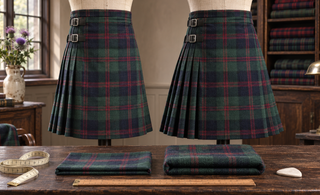
The difference between a 13oz and 16oz tartan kilt is small on a fabric label but noticeable in a finished garment. A 13oz cloth is normally classed as medium weight: easier to carry, comfortable across more seasons, and practical for travel or long events. A 16oz cloth is heavyweight: firmer, more structured, and especially good at holding deep pleats and producing the traditional swing many wearers expect.
Neither weight is automatically “better.” The right choice depends on climate, yardage, body measurements, occasion, fabric fibre, and how often you plan to wear the kilt. An 8-yard kilt in 16oz cloth behaves very differently from a 5-yard kilt in 13oz cloth, even when both use the same tartan.
Quick answer: Choose 13oz for a versatile medium-weight kilt that is easier for warm weather, travel, long days, and first-time wearers. Choose 16oz for stronger structure, deeper pleats, wind resistance, formal presence, and a more substantial traditional feel. Compare yardage and fibre as well as the ounce number.
13oz vs 16oz Kilt: At a Glance
| Feature | 13oz medium weight | 16oz heavyweight |
|---|---|---|
| Overall feel | Balanced, easier to wear for long periods | Substantial, structured, traditional |
| Pleat definition | Good with careful construction and pressing | Excellent crease retention and deeper visual structure |
| Swing | Fluid and responsive | Pronounced, controlled, and weighty |
| Warm climates | Usually the more comfortable option | Can feel heavy, especially with 8 yards of cloth |
| Cool or windy weather | Works with suitable layers | More resistant to wind and more substantial around the legs |
| Travel and packing | Lighter and easier to transport | Bulkier but can recover well when properly hung and pressed |
| Formal wear | Fully suitable when tailored well | Traditional formal presence and crisp silhouette |
| Best for | Year-round use, warmer regions, travel, long events | Cold weather, ceremonial wear, full 8-yard kilts, strong drape |
What Does “13oz” or “16oz” Mean?
The ounce rating normally describes the weight of a linear yard of fabric at a stated cloth width. It does not mean the entire finished kilt weighs 13 or 16 ounces. A kilt contains several yards of cloth, plus lining, canvas, straps, buckles, and stitching.
Width matters. Two fabrics both sold as 13oz may not be identical if the mills use different widths, fibres, yarns, finishes, or measurement conventions. For the most useful comparison, compare products from the same seller or mill and confirm:
- the cloth width;
- the fibre content;
- the total yardage used;
- the kilt’s pleat depth and construction;
- whether the figure refers to cloth weight or a marketing category.
In the traditional kilt trade, roughly 13oz is commonly described as medium weight and roughly 16oz as heavyweight. Some mills also offer lighter 10–11oz cloth and very heavy 18–22oz regimental cloth. These bands are useful guides rather than one universal industry law.
How Heavy Is a Finished Kilt?
The finished weight depends on more than the fabric label. Yardage is often the biggest second variable. A 5-yard kilt uses substantially less cloth than an 8-yard kilt, so it may feel lighter even when made from the same weight category.
A simple multiplication illustrates the difference but should not be treated as an exact garment weight:
- Five linear yards of nominal 13oz cloth begin with about 65 ounces of fabric before cutting and tailoring.
- Eight linear yards of nominal 16oz cloth begin with about 128 ounces of fabric before cutting and tailoring.
The maker may trim cloth, use different widths, shape the fell, and add internal materials, so the final garment will not match that arithmetic exactly. The calculation simply shows why “13 versus 16” cannot be separated from “5 yards versus 8 yards.” For the full construction comparison, read our 5-yard vs 8-yard kilt guide.
What Is a 13oz Tartan Kilt?
A 13oz tartan is a medium-weight cloth suitable for traditional kilts, trousers, waistcoats, jackets, skirts, and accessories. In a kilt, it offers a useful balance between structure and wearability. It is substantial enough to form proper pleats but lighter than a traditional heavyweight build.
Advantages of 13oz cloth
- More comfortable for warm climates and indoor events.
- Easier to wear for a full wedding day, festival, or long journey.
- Lighter to pack in luggage.
- Good movement without excessive mass.
- Suitable for 5-yard kilts and many 8-yard builds.
- Often available in a broad range of modern and traditional tartans.
- A practical first-kilt choice when you are unsure how often you will wear it.
Possible trade-offs
Medium-weight cloth may need more careful pressing after travel or extended sitting. Very deep pleats can feel softer than the same construction in heavyweight cloth. In strong wind, the lighter garment has less mass helping it settle. None of these issues makes 13oz unsuitable; they simply affect how the kilt behaves.
For a current example, see the men’s traditional 5-yard, 13oz tartan kilt. It is a useful reference for a lighter construction intended for comfort and easy wear.
What Is a 16oz Tartan Kilt?
A 16oz tartan is generally classified as heavyweight cloth. It has more body in the hand, creates a firm tailored silhouette, and supports deep pleats particularly well. This is the weight many wearers picture when they imagine a substantial traditional men’s kilt.
Advantages of 16oz cloth
- Strong pleat definition and crease retention.
- More pronounced swing in a full kilt.
- Extra stability in windy weather.
- Traditional weight and presence for formal Highland dress.
- Excellent drape over the hips and seat when correctly tailored.
- Durable feel for frequent wear.
- Well suited to deep knife, box, and specialist pleat constructions.
Possible trade-offs
Heavyweight cloth adds bulk to luggage and can feel tiring during a very long day, especially in an 8-yard build. In hot or humid conditions, the combined layers behind each pleat may feel warmer even if the cloth itself remains breathable. A full heavyweight kilt also needs a sturdy hanger and enough wardrobe space for proper storage.
The Rose Ancient 8-yard, 16oz traditional tartan kilt shows the fuller construction and substantial cloth many buyers prefer for formal use.
Does a 16oz Kilt Feel Much Heavier?
The difference between one linear yard of 13oz and 16oz cloth is only three ounces. Across five or eight yards, however, that difference accumulates. Add the deeper folds of a full kilt and the garment can feel noticeably more substantial around the waist and hips.
Wearer perception also varies. Someone accustomed to tailored Highland dress may appreciate the reassuring weight. A first-time wearer moving from trousers or a lightweight utility kilt may notice it immediately. The fit determines whether that mass feels balanced: a correct natural-waist measurement spreads the load far better than a loose kilt hanging from the hips.
Which Weight Holds Pleats Better?
All else equal, 16oz cloth usually holds sharp creases and deep pleats more firmly. The extra body helps the pleats fall back into line after walking or turning. This is one reason heavyweight cloth is popular for formal kilts, pipe-band uniforms, and specialist box-pleated constructions.
A well-made 13oz kilt can still have excellent pleats. The maker must match pleat depth, face width, sett size, canvas, stitching, and pressing to the cloth. Poor construction will not be rescued by heavier fabric, while skilled tailoring can make medium-weight cloth look crisp and balanced.
Learn how fabric is folded and aligned in our guide to knife, box, Kingussie, sett, and stripe pleating.
Which Weight Has the Best Swing?
Heavyweight cloth is famous for a controlled, dramatic swing. More mass creates momentum as the wearer moves, while deep pleats open and settle with authority. This effect is especially noticeable in an 8-yard kilt.
Medium-weight cloth feels quicker and more fluid. It responds easily when walking, climbing stairs, dancing, or sitting. Some wearers prefer that lighter motion rather than the pronounced swing of a heavyweight garment.
There is no single winner because swing depends on:
- yardage;
- number and depth of pleats;
- fabric fibre and finish;
- sett size;
- fit across the seat;
- pressing and condition;
- the wearer’s movement.
Is 16oz Warmer Than 13oz?
Usually, a full 16oz kilt feels more substantial and may offer better wind resistance, but warmth is not determined by the ounce rating alone. A kilt is open below the waist, and most heat control comes from the entire outfit and environment.
Important factors include:
- five-yard versus eight-yard construction;
- pleat depth and fabric overlap;
- natural wool versus acrylic wool or another fibre;
- lining and internal canvas;
- wind, humidity, and temperature;
- jacket, waistcoat, shirt, hose, outerwear, and footwear;
- how active the wearer is.
A 13oz 8-yard kilt may feel warmer than a shallow 16oz 5-yard kilt because more cloth is layered around the wearer. In winter, build the outfit as a system rather than expecting the fabric label to do all the work. Our fall and winter tartan kilt guide covers practical cold-weather layers.
13oz vs 16oz for Warm Weather
For hot summers, humid climates, crowded indoor venues, or long outdoor festivals, 13oz is normally the safer choice. It reduces total mass and can be easier to manage when walking or standing for hours.
Do not assume a lighter kilt will feel like shorts. Traditional kilts still contain overlapping aprons, stitched pleats, lining, and several layers of cloth at the back. Choose a breathable shirt, avoid unnecessary waistcoat and jacket layers, and take breaks in shade.
If extreme heat is your main concern, also consider a 5-yard construction or a modern cotton utility kilt. Compare the current utility kilt collection if pockets, washable cotton, and lower bulk are more important than a fully traditional silhouette.
13oz vs 16oz for Winter and Wind
A 16oz kilt is an excellent choice for cool, wet, or windy conditions. The cloth’s extra body helps the pleats stay stable and makes the garment feel more substantial. Deep pleats also place more material around the back and sides.
For winter events, wear proper hose, boots or brogues, a warm jacket, and an appropriate outer layer. A scarf, gloves, and coat often change comfort more than moving from medium to heavyweight tartan alone.
Which Weight Is Better for Weddings?
Both 13oz and 16oz can look formal. Tailoring, fit, pressing, tartan choice, jacket, sporran, hose, and shoes matter more than the three-ounce difference on the cloth label.
Choose 13oz for:
- summer weddings;
- destination events;
- long travel days;
- indoor receptions;
- groomsmen who are new to kilts;
- events involving extensive dancing.
Choose 16oz for:
- autumn and winter weddings;
- formal Highland dress;
- outdoor ceremonies in exposed locations;
- a full 8-yard traditional silhouette;
- wearers who value firm structure and deep pleats.
Which Weight Is Better for Travel?
13oz is easier to pack, carry, and wear through airports or long drives. It takes less luggage space and reduces the load of a full outfit that may already include a jacket, brogues, hose, sporran, and accessories.
A 16oz kilt can still travel well. Fold or roll it along the established pleat direction, avoid placing heavy items on top, unpack promptly, and hang it from strong clips spread across the waistband. Minor creasing often relaxes after hanging, while lost pleat alignment may require careful pressing.
Which Weight Is Better for Larger or Smaller Wearers?
There is no universal body-size rule. Heavyweight cloth can drape smoothly across a fuller frame and resist collapsing into soft wrinkles. Medium-weight cloth reduces total mass and can be more comfortable around the waist during long wear.
The critical point is fit. The waist should sit at the intended natural-waist position, the seat must allow the pleats to hang closed while standing, and the drop should reach the agreed knee position. Incorrect measurements cause flare, sag, pulling, and discomfort regardless of fabric weight.
Use the waist, hips, and length measuring guide before ordering a custom kilt.
Does Fibre Matter as Much as Weight?
Yes. A 16oz natural wool tartan and a 16oz acrylic-wool tartan may share a nominal weight but differ in texture, resilience, warmth, cleaning needs, price, and how they respond to moisture. Cotton, polyviscose, and blended fabrics behave differently again.
When comparing products, do not stop at the ounce figure. Confirm:
- fibre composition;
- cloth weight;
- fabric width;
- finish and surface feel;
- cleaning instructions;
- yardage and construction;
- whether the tartan is woven or printed.
A quality kilt is the result of appropriate material plus accurate cutting, internal support, balanced pleating, strong stitching, and correct pressing.
13oz vs 16oz for Everyday Wear
For regular use, 13oz offers an easy balance. It is substantial enough to feel like a traditional garment but manageable for dinners, club meetings, festivals, travel, and casual days. A 5-yard medium-weight kilt is especially practical if you value comfort and packability.
Choose 16oz if everyday wear includes cool weather, outdoor work, marching, frequent formal events, or a preference for strong drape. The garment will demand more storage space, but many wearers enjoy the dependable way it settles.
What About 10oz, 11oz, and Regimental Cloth?
10–11oz lightweight tartan
Lightweight tartan is common for trousers, skirts, dance garments, waistcoats, ties, sashes, and accessories. It can be used for kilts, especially where heat or movement is the priority, but it may need more frequent pressing and will not provide the same heavy swing.
18–22oz regimental tartan
Regimental cloth is exceptionally heavy and available in a limited number of designs. It is associated with military-style construction, durability, and a very substantial feel. It is not the automatic choice for a civilian first kilt and can be difficult to source, pack, and wear in warm conditions.
How to Choose in Five Questions
- Where will you wear it? Warm indoor venues and travel favour 13oz; exposed winter events favour 16oz.
- How much cloth do you want? A full 8-yard build adds more total weight than a 5-yard build.
- How important is strong pleat structure? Heavyweight cloth has the advantage, especially for deep or box pleats.
- How long will you wear it? Medium weight can be easier for an entire day of standing, walking, and dancing.
- Which tartan and fibre are available? The ideal design may be woven only in one weight or material.
Care and Pressing
Heavier cloth may hold creases longer, but both weights need correct care:
- Hang the kilt from strong clips distributed across the waistband.
- Air it after wear before placing it in a garment bag.
- Brush away dry surface dirt gently.
- Follow the product’s fibre-specific cleaning instructions.
- Align every pleat before pressing.
- Use a pressing cloth and controlled steam rather than dragging a hot iron.
- Ask a kiltmaker or specialist cleaner for help if several pleats lose alignment.
Do not assume heavyweight cloth is indestructible. Poor storage, excessive heat, harsh chemicals, and incorrect pressing can damage either weight.
Frequently Asked Questions
Is 13oz too light for a traditional kilt?
No. Thirteen-ounce cloth is a widely used medium weight and can produce an excellent traditional kilt. Construction, yardage, fit, and pressing determine the final quality.
Is 16oz the best kilt weight?
It is an excellent traditional choice for structure and pleat retention, but it is not best for every climate or wearer. A 13oz kilt may be more practical for travel, heat, or long events.
Will a 16oz kilt be too hot?
Not always. Weather, yardage, fibre, activity, and upper-body layers all affect comfort. It can feel heavy in hot, humid conditions, especially in an 8-yard build.
Does 16oz last longer than 13oz?
Heavy cloth can offer greater abrasion resistance and structure, but lifespan depends on fibre quality, tailoring, wear frequency, cleaning, storage, and care. A well-maintained 13oz kilt can serve for many years.
Which weight is better for box pleats?
Heavyweight cloth is often preferred because it supports the broad fold structure and holds a firm crease. Medium weight can work when the pleat plan and construction are designed for it.
Can I get the same tartan in both weights?
Sometimes. Mills do not weave every tartan in every weight, and colour shades or sett scale may vary between ranges. Confirm availability before finalising a custom order.
Does 13oz mean the whole kilt weighs 13 ounces?
No. The rating refers to fabric weight, normally per linear yard at a stated width. The finished kilt contains multiple yards plus internal materials and hardware.
Is 13oz better for children or women?
Medium and lightweight cloth can be easier for smaller wearers, skirts, and active use, but garment design and personal preference matter more than gender alone.
Should a first kilt be 13oz or 16oz?
Choose 13oz if versatility, comfort, travel, or warm weather leads your priorities. Choose 16oz if you want the most substantial traditional feel, strong pleats, and regular cold-weather or formal use.
Final Verdict
A 13oz kilt is the versatile all-rounder: medium weight, comfortable, travel-friendly, and fully capable of formal wear. A 16oz kilt is the structured traditionalist: heavier, firmer, better at holding deep pleats, and especially satisfying in a full 8-yard build.
Make the decision by comparing the whole garment—not one number. Consider yardage, fibre, climate, fit, pleat style, occasion, and how long you will wear it. Browse the Kilt Experts men’s tartan kilt collection to compare traditional designs, then use the complete kilt collection if you also want utility, hybrid, leather, or modern alternatives.