
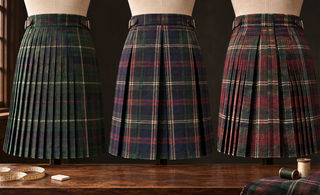
A kilt’s pleats are not just decoration. They control how the garment hangs, how freely it moves, how the tartan appears from the back, and how much cloth is carried around the wearer. That is why two kilts made from the same tartan can look and feel surprisingly different.
The most common choice is a knife-pleated kilt, but box pleats and the rarer Kingussie arrangement offer their own character. There is also a second decision that is easy to confuse with pleat type: whether the tartan is pleated to the sett or pleated to a stripe. This guide explains each option, the trade-offs that matter, and how to choose a pleating style that suits your wardrobe rather than simply following a label.
Quick answer: Knife pleats fold in one direction and are the modern standard. Box pleats use paired, opposing folds and create a broader, more architectural rhythm. Kingussie pleating combines knife and box-pleat ideas in a distinctive historical arrangement. Any of these may be planned around the tartan’s full sett or around a chosen vertical stripe.
What Are Kilt Pleats?
A traditional kilt has two flat, overlapping aprons at the front and a pleated section around the sides and back. Above the hip, those pleats are stitched down in a shaped area called the fell. Below the fell, they open and move. This is the part that creates the familiar swing when the wearer walks or turns.
Several measurements work together:
- Pleat face: the visible strip of tartan seen from the outside.
- Pleat depth: the cloth folded behind each visible face.
- Number of pleats: influenced by the wearer’s measurements, the tartan sett, cloth width, and the maker’s plan.
- Fell length: the stitched-down distance from the waistband toward the hip.
- Yardage and cloth weight: major factors in fullness, drape, warmth, and total garment weight.
Pleat style describes the direction in which cloth is folded. Tartan alignment describes which part of the pattern is displayed on the pleat faces. They are related decisions, but they are not the same decision.
Knife vs Box vs Kingussie Pleats: At a Glance
| Pleat style | How it is formed | Visual effect | Typical appeal |
|---|---|---|---|
| Knife pleat | Successive folds face the same direction | Crisp, rhythmic lines with fluid swing | The versatile modern standard for formal and everyday tartan kilts |
| Box pleat | Paired folds face toward or away from a central line | Broader, balanced panels with a structured look | Historical construction, specialist commissions, reenactment, and a less common silhouette |
| Kingussie pleat | A mixed arrangement using box- and knife-pleat principles | Alternating direction and a distinctive repeating rhythm | Collectors and wearers seeking unusual historic character |
This comparison describes the fold geometry, not the exact amount of cloth. A shallow knife-pleated kilt can feel lighter than a deeply pleated one, and a box-pleated kilt can be engineered with different amounts of overlap. Ask about actual fabric weight, yardage, and pleat depth before drawing conclusions from the style name alone.
Knife Pleats: The Modern Standard
Knife pleats—also called side pleats—are folded successively in the same direction. From the outside, the pleat edges form a clean series of narrow vertical lines. Because the folds travel consistently around the back, the kilt opens smoothly in motion and then settles back into an orderly shape.
Most contemporary traditional kilts use knife pleats. The arrangement works well with a wide range of tartan setts and makes it practical to carry extra cloth in deeper underpleats. That flexibility is one reason knife pleating is commonly seen in fuller kilts.
Advantages of knife pleats
- Familiar, classic appearance for weddings, Highland games, dinners, and everyday wear.
- Excellent movement and a pronounced swing when sufficient cloth is used.
- Works with both pleating to the sett and pleating to a stripe.
- Widely understood by experienced kiltmakers, making alterations and repressing easier to discuss.
- Suitable for lighter 5-yard builds and fuller 8-yard constructions.
Points to consider
More pleats are not automatically better. A maker must balance the tartan’s repeat, the wearer’s seat measurement, the desired pleat face, and the available cloth. Very narrow faces can look busy in a large or complex tartan, while very wide faces may reduce the visual rhythm. The best plan preserves the character of the tartan and produces a clean fit across the hips.
Box Pleats: Balanced, Historical, and Distinctive
A box pleat is created from two folds arranged in opposing directions. On a classic outward box pleat, the folds open away from a central line; on an inverted box pleat, they meet toward the center beneath the visible surface. Kiltmakers may use the term in a more specialized way when describing historical or military constructions, so a sketch or sample is more useful than relying on the name alone.
Box pleats give the back of a kilt a broader, more measured rhythm. They are less common in modern civilian kilts, which makes them visually distinctive. Historical evidence shows box-pleated kilts well before the modern knife-pleated standard became dominant.
Are box-pleated kilts lighter?
They can be, but they are not inherently light. A traditional four-yard box-pleated build may use less cloth than a full eight-yard knife-pleated kilt. A deeper military-style box construction can use much more cloth and create substantial internal overlap. The correct comparison is therefore not “box versus knife” in isolation; it is the entire specification:
- total yardage;
- fabric weight per yard;
- pleat depth and overlap;
- number and width of pleats;
- lining, canvas, and internal construction.
If you want a lighter traditional garment, compare the full specification with our 5-yard vs 8-yard kilt guide. You can also see a current 5-yard, 13oz tartan kilt and contrast it with a fuller 8-yard, 16oz tartan kilt. These examples make clear why yardage and cloth weight matter as much as the folding method.
What Is Kingussie Pleating?
Kingussie pleating is a rare specialty style that combines characteristics of box and knife pleats. Rather than sending every fold in one continuous direction, the arrangement changes direction in a planned sequence. The result is a distinctive, balanced pattern across the back.
The name is associated with a surviving historical kilt linked to Kingussie in the Scottish Highlands. Modern makers who reproduce the style may interpret construction details differently, especially when adapting it to a particular tartan, waist size, or cloth width. For that reason, Kingussie is best treated as a bespoke design conversation rather than a standard menu option.
Choose it because you appreciate its unusual construction and historical character—not because it is universally more formal, more comfortable, or more authentic than a well-made knife- or box-pleated kilt. Quality depends on fit, balance, pressing, and workmanship across the whole garment.
Pleated to the Sett vs Pleated to a Stripe
After choosing the fold style, the maker must decide what part of the tartan appears on the pleat faces. This choice can change the back view more dramatically than many first-time buyers expect.
Pleated to the sett
The sett is the complete repeating unit of a tartan. When a kilt is pleated to the sett, the visible faces are planned so the tartan’s overall pattern appears to continue across the pleated area when the garment is hanging closed. The pleats still open during movement, revealing the hidden colors and lines inside.
This is the most common civilian treatment and an excellent default when you want the back of the kilt to resemble the front apron. It works particularly well when the full tartan composition—not one isolated line—is the main attraction.
Pleated to a stripe
When pleated to a stripe, the maker centers a selected vertical line from the tartan on each pleat face. The repeated line creates strong vertical columns across the back. Different stripe choices can produce very different results from the same cloth: one may emphasize a bright overcheck, while another creates a darker and more restrained field.
Pleating to a stripe has strong military and pipe-band associations and is sometimes called military pleating. However, terminology varies by maker and regiment. “Military” does not always tell you whether the actual folds are knife pleats or a specialized box construction. If accuracy matters for a uniform, confirm the exact regimental specification rather than relying on a general label.
| Alignment | What you see when the pleats are closed | Best when |
|---|---|---|
| To the sett | The overall tartan repeat appears to continue | You want visual continuity between the apron and back |
| To a stripe | One selected vertical line repeats across the pleat faces | You want a bold rear view, pipe-band character, or a specific uniform tradition |
Before ordering, inspect a full-width image of the tartan rather than a tiny swatch. Identify two or three vertical lines that could be centered on the pleats and ask how each would affect the dominant color. If you are still selecting cloth, start with our guide to choosing a tartan for your kilt.
How Pleat Depth, Yardage, and Fabric Weight Change the Feel
Pleats are three-dimensional storage for fabric. A garment that looks simple from the outside may hold several layers of cloth behind every visible face. Those hidden layers affect movement, warmth, durability, and how firmly the kilt settles after a step.
Yardage
A 5-yard kilt usually has shallower pleats and less total cloth than an 8-yard kilt of the same size and fabric. It can be easier to pack and cooler in warm conditions. An 8-yard build generally offers deeper pleats, greater fullness, and a more dramatic swing. Larger waist sizes, unusually large tartan setts, or specialized pleat plans can change the exact requirement.
Fabric weight
Cloth weight is commonly expressed in ounces. Heavier tartan tends to hold a sharp crease and resist wind, but it also adds mass. Lighter cloth may be more comfortable for travel or warm-weather wear. Construction quality and fiber content also matter, so ounce weight should be treated as one variable rather than a complete measure of quality.
Pleat depth and face width
Deeper underpleats add fullness behind a relatively narrow visible face. This can improve swing and help the kilt settle, but it also increases layered bulk. A larger tartan repeat may require wider faces if the maker is reproducing the sett accurately. Forcing an unsuitable face width can distort the pattern.
Warmth
No pleat style is automatically the warmest. Warmth depends on cloth weight, fiber, yardage, overlap, lining, wind, temperature, and how the wearer layers the rest of the outfit. A deep knife-pleated 8-yard kilt in heavy cloth may be warmer than a lightly built box-pleated kilt; a heavily overlapped box construction may reverse that result.
Which Kilt Pleat Style Is Best for You?
For a first traditional kilt
Choose knife pleats, usually pleated to the sett, unless a specific tartan or uniform tradition points elsewhere. It is versatile, familiar, and easy to style for a wide range of occasions. Browse the current men’s tartan kilt collection to compare setts, weights, and fuller or lighter constructions.
For weddings and formal events
Knife pleats remain the safest all-purpose choice. Pleating to the sett gives a cohesive look in photographs, while pleating to a stripe can create a strong back view for a groom, best man, or coordinated party. Formality comes mainly from the full outfit, cloth, fit, and condition—not from one pleat geometry.
For pipe bands and regimental wear
Follow the band’s or regiment’s documented specification. It may prescribe the tartan, the chosen stripe, the direction and type of pleat, yardage, spacing, and other details. Small deviations that look harmless in an individual kilt become obvious when a group stands in formation.
For historical interest or reenactment
Box pleats or Kingussie construction may be appropriate, but date, region, unit, and the quality of the source all matter. Avoid assuming there was one universal historical kilt. Nineteenth-century tailoring included experimentation, hybrid constructions, and changing military and civilian preferences.
For warm climates and travel
Prioritize lower total weight, breathable layers, and packability. A 5-yard knife-pleated kilt in a suitable cloth may be more practical than selecting a rare pleat style. When packing, roll or fold along the existing pleat direction and avoid crushing the fell under heavy luggage.
For a distinctive bespoke commission
Box or Kingussie pleating can make the construction itself part of the story. Ask the maker for a diagram, a sample fold, or a photograph of a comparable completed kilt. Confirm which stripe or part of the sett will appear on the pleat faces before cloth is cut.
Fit Matters More Than the Pleat Name
A beautiful pleat plan cannot rescue incorrect measurements. A traditional kilt should sit securely at the intended waist, follow the hips without strain, and reach the agreed length. If the waist is too loose, the garment can drop and the pleats may flare. If the seat is too tight, the pleats can pull open while standing and lose their clean vertical line.
Use a flexible tape, keep it level, and measure over the clothing you expect to wear. Do not substitute a trouser label for an actual body measurement; modern trousers often sit lower than a traditional kilt and their marked size may not match the tape. Follow the step-by-step kilt measuring guide before placing a custom order.
How to Care for Kilt Pleats
- Hang it correctly. Use strong kilt hangers with clips spread across the waistband so the weight is distributed evenly.
- Let it air after wear. Brush away dry surface dirt and allow moisture to dissipate before placing it in a garment bag.
- Do not flatten it under storage. Long compression can soften creases and create unwanted folds.
- Follow the care label. Fiber, lining, and construction determine the correct cleaning method.
- Press with care. Align every fold before applying controlled steam and pressure. Protect the cloth with a pressing cloth and avoid dragging the iron sideways.
- Use a specialist when needed. If several pleats have lost alignment, a kiltmaker or cleaner familiar with Highland wear is safer than aggressive home pressing.
Temporary tacking threads may sometimes be used to hold pleats during construction or shipping. Do not cut unfamiliar stitching merely because it looks loose. Check the product instructions or ask the maker first; permanent bar tacks and structural stitches can be damaged by guessing.
Questions to Ask Before Ordering
- Is the kilt knife pleated, box pleated, or made with another arrangement?
- Will the tartan be pleated to the sett or to a stripe?
- If to a stripe, exactly which vertical line will be centered?
- How much cloth is used for my measurements?
- What is the fabric weight and fiber composition?
- How deep are the underpleats, and approximately how many pleats will there be?
- Can the maker show a rear-view example in a similar sett?
- What measurements and fit allowance are required?
- How should the finished kilt be cleaned, pressed, and stored?
These questions turn a vague preference into a build specification. They also prevent a common disappointment: choosing a tartan from the front apron only, then discovering that the pleated back emphasizes a color you did not expect.
Frequently Asked Questions About Kilt Pleats
How many pleats should a kilt have?
There is no universal correct number. It depends on waist and seat measurements, tartan sett size, pleat face width, yardage, and the maker’s construction plan. Balance and pattern alignment matter more than chasing a particular count.
Are all 8-yard kilts knife pleated?
No. Knife pleating is common because it accommodates deep overlap efficiently, but box and specialized military constructions can also use substantial yardage. Confirm the actual specification.
Is pleating to the stripe the same as knife pleating?
No. “To the stripe” describes tartan alignment. “Knife” describes fold direction. A knife-pleated kilt can be aligned either to the sett or to a selected stripe.
What does military pleating mean?
It often means that a selected stripe is repeated down the pleat faces, but historical and modern usage varies. A specific uniform may require knife pleats, military box pleats, or another prescribed construction.
Do box pleats use less fabric?
A traditional shallow box-pleated kilt may use less cloth than a full modern knife-pleated kilt, but deeper box and military constructions can use much more. Compare total yardage and overlap, not the name alone.
Which pleats have the best swing?
Swing comes from the interaction of yardage, depth, cloth weight, pressing, and fit. Full knife pleats are famous for fluid movement, but a well-balanced box construction can move beautifully too.
Can an existing kilt be changed from pleated to the sett to pleated to a stripe?
In theory a complete rebuild may be possible, but it is not a simple alteration. The kilt may need to be dismantled, replanned, reshaped, and resewn, and the available cloth may limit the result. A specialist must inspect it first.
Can utility kilts have knife or box pleats?
Yes, but their construction vocabulary differs because utility kilts may use cotton, pockets, hardware, panels, or removable features. If you are comparing categories, read the traditional kilt vs utility kilt guide before assuming the same pleat terminology guarantees the same feel.
Final Verdict
For most buyers, a knife-pleated kilt aligned to the sett is the dependable starting point: versatile, balanced, and visually continuous. Pleating to a stripe adds a bolder, often military-influenced back view. Box pleats bring historical structure, while Kingussie pleating offers rare specialist character.
The best choice is the one that combines the right tartan display with the right total weight, yardage, movement, and fit. Decide what you want the back of the kilt to show, ask how the hidden cloth is engineered, and verify the complete construction rather than choosing from a style name alone. Explore the full Kilt Experts kilt collection when you are ready to compare traditional, modern, and specialist options.