
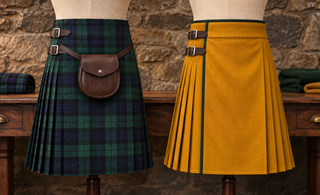
Irish kilts and Scottish kilts can look similar at first glance, but they do not have the same history, symbolism or traditional styling. The Scottish kilt developed from Highland dress and is strongly associated with tartan, clans, regiments and formal Highland wear. The Irish kilt is a later cultural adoption, most closely connected with the Gaelic Revival, pipe bands, military tradition and modern expressions of Irish heritage.
That does not make one more meaningful than the other. It simply means that choosing an Irish kilt vs Scottish kilt should begin with accurate history and the identity you want the outfit to express.
This guide explains the key differences in origin, tartan, color, construction, jackets, accessories and wedding styling. It also answers the practical buying question: which kilt should you choose?
Irish Kilt vs Scottish Kilt: Quick Comparison
| Feature | Scottish Kilt | Irish Kilt |
|---|---|---|
| Historical development | Developed from Scottish Highland dress, with the tailored small kilt established in the early 18th century | Adopted mainly during the late-19th- and early-20th-century Gaelic Revival and by pipe bands and regiments |
| Classic appearance | Tartan cloth, flat front aprons and pleats at the back | Often solid saffron or green in band and regimental traditions; modern Irish tartans are also popular |
| Identity | Clan, district, military, organizational or universal tartan | National, county, regional, family-inspired or general Irish heritage |
| Tartan history | Deeply associated with Scottish Highland dress, though many fixed clan associations were formalized over time | Most named Irish county and national tartans are modern symbolic designs rather than ancient official patterns |
| Formal jacket | Prince Charlie, Argyll or tweed jacket | Brian Boru or Kilkenny-style jacket, although Scottish-style jackets are also worn |
| Accessories | Sporran, hose, flashes, belt, brogues and optional clan details | Similar foundation, often with Irish or Celtic motifs; pipe-band dress may add a caubeen or cloak |
| Best for | Scottish weddings, Highland events, clan gatherings and formal Highland dress | Irish weddings, heritage celebrations, pipe bands, St Patrick’s events and Celtic occasions |
The Short Answer: What Is the Main Difference?
The main difference is cultural context.
A Scottish kilt belongs to the established tradition of Highland dress. Tartan selection, pleating, yardage and accessories can all communicate a level of formality and a connection to a clan, regiment, region or organization.
An Irish kilt uses the kilt silhouette to express Irish identity. Historically, Irish kilt wear is much newer. Solid saffron became especially recognizable in Irish pipe-band and regimental uniforms, while modern wearers may choose green, Irish National, county or other Irish-themed tartans.
Construction can be almost identical. Both can use a flat front, pleated back, leather fastening straps and knee-length proportions. Therefore, you cannot always identify nationality from the cut alone; the cloth, color and complete outfit often provide the stronger clues.
Scottish Kilt History in Brief
The modern Scottish kilt evolved from the belted plaid, often called the great kilt or feileadh mòr. This larger length of cloth was wrapped around the lower body, belted at the waist and arranged over the upper body in different ways. By the early 18th century, the smaller tailored kilt—essentially the lower portion with sewn pleats—had become established.
Over time, Highland regiments, romantic interest in Scotland, royal influence and civilian tailoring helped shape the formal Highland dress recognized today. Tartan became one of its most visible features.
It is important not to oversimplify this history. Scottish people used patterned woven cloth long before the modern retail idea of a clan tartan. However, many fixed tartan-to-clan associations were recorded, promoted or standardized during the 18th and 19th centuries rather than remaining unchanged from remote antiquity.
Today, wearers choose from clan, district, military, corporate, commemorative and universal tartans. If you are unsure which category fits you, see our complete guide to choosing a tartan.
Irish Kilt History in Brief
The tailored kilt was not the ordinary national dress of medieval Ireland. Historical Irish dress included garments such as the léine, a long tunic, and the brat, a cloak. Claims that the modern Irish kilt has an unbroken ancient history are not supported by mainstream dress-history research.
The Irish kilt emerged mainly during the Gaelic Revival of the late 19th and early 20th centuries, when writers, educators, cultural organizations and nationalists sought visible expressions of Irish identity. Pipe bands, schools, military units and cultural groups helped establish the kilt as part of a modern Irish ceremonial language.
Saffron kilts became particularly recognizable. Irish pipers and some regimental traditions used solid saffron with green or dark jackets, while other groups adopted green kilts. Modern Irish tartans later added more choices for people who wanted to represent Ireland, a county or a heritage connection through patterned cloth.
For a classic solid-color interpretation, the Saffron 16 oz kilt with leather straps reflects the color strongly associated with Irish pipe-band and regimental styling.
Are Irish Tartans Ancient?
Most popular Irish county and national tartans are modern. They are meaningful heritage symbols, but they should not be presented as ancient official uniforms worn continuously by every county or family.
Tartan cloth itself is not foreign to Irish history. Archaeological and textile evidence shows that patterned cloth was present in Ireland, including the famous Dungiven or Ulster find dated to the early modern period. What is newer is the modern system of named Irish county, national and family tartans.
Many well-known Irish county tartans were designed and marketed in the late 20th century. They can still be a thoughtful way to honor a county connection, birthplace, family story or Irish diaspora identity. Historical age is not the only source of cultural meaning; accuracy comes from describing the design honestly.
If you want a broad symbol rather than a county-specific pattern, the Irish National tartan traditional kilt offers both 5-yard and 8-yard options. Buyers drawn to softer regional color may prefer the Connemara Irish Modern tartan kilt.
Scottish Tartan vs Irish Tartan
Scottish tartans
Scottish tartans may identify a clan, district, regiment, organization or universal theme. A surname can be a useful starting point, but it is not the only valid way to choose. Many people wear universal tartans such as Black Watch or select a pattern because its colors suit the event.
Browse tartan kilts for men to compare traditional patterns and styles. Yardage matters as well as color: an 8-yard kilt produces deeper pleats and a fuller formal drape, while a 5-yard kilt is lighter and often more practical for occasional wear. Our 5-yard vs 8-yard comparison explains the difference.
Irish tartans
Irish tartans usually express national, county or regional identity rather than the Scottish clan-tartan model. The Irish National, Irish Heritage, Ulster and Connemara families of designs are common choices. Some sellers also offer tartans associated with Irish surnames, but buyers should check the design’s provenance before assuming an ancient family connection.
For an Ulster example, the Irish Ulster tartan kilt with leather straps provides a clear heritage-focused option. Availability, sizing and customization should always be confirmed on the current product page.
Do Irish and Scottish Kilts Look Different?
Sometimes yes, but not always.
A tartan kilt with a full Prince Charlie outfit will usually read as Scottish Highland dress. A solid saffron kilt with an Irish-style jacket or pipe-band uniform will usually read as Irish. The distinction becomes less obvious when an Irish wearer chooses a modern county tartan cut in the same pleated construction as a Scottish kilt.
Look at four elements together:
- Cloth: Scottish tartan, Irish tartan or solid saffron/green.
- Jacket: Prince Charlie, Argyll, tweed, Brian Boru or Kilkenny-inspired style.
- Motifs: clan or regimental details versus Irish or broader Celtic symbols.
- Context: wedding, pipe band, heritage event, military ceremony or casual celebration.
No single accessory guarantees nationality. Shamrocks, Celtic knotwork and crests may help communicate the intended identity, but modern outfits often mix influences.
Irish vs Scottish Kilt Jackets
Prince Charlie jacket
The Prince Charlie jacket is a formal Scottish evening option, usually worn with a waistcoat, bow tie, dress sporran and formal kilt hose. Its short cut leaves the front of the kilt visible and creates the Highland equivalent of a black-tie silhouette.
Argyll and tweed jackets
Argyll jackets are versatile for daytime or evening events. Tweed jackets create a softer country look and work especially well for weddings and semi-formal gatherings. Both can be worn with Scottish or Irish heritage outfits when the styling is coherent.
Brian Boru jacket
The Brian Boru jacket is widely marketed as a formal Irish kilt jacket. It shares the short, dressy structure of Highland evening jackets but often uses Irish-inspired detailing. The Brian Boru Irish kilt jacket and waistcoat is a useful example when building an Irish formal outfit.
Browse all current kilt jackets before choosing. The event’s dress code, time of day and desired level of formality matter more than forcing a rigid nationality rule.
Sporrans and Accessories: What Changes?
Both Scottish and Irish kilt outfits may include a sporran because traditional kilts usually do not have built-in pockets. The practical function is the same; decoration may change.
A Scottish outfit might use a plain leather day sporran, a semi-dress style with fur, or an ornate dress sporran. Clan, thistle, stag or regimental motifs are common. An Irish outfit may use Celtic knotwork, harp or shamrock-inspired detailing, although a simple leather sporran works with either.
Other shared accessories include:
- kilt hose and flashes;
- ghillie brogues or other formal shoes;
- kilt belt and buckle when appropriate;
- kilt pin placed on the lower open apron;
- tie, bow tie or cravat matched to the jacket;
- optional plaid, brooch or heritage badge.
Browse sporrans and the wider kilt accessories collection to coordinate the outfit. Choose motifs for personal meaning, but avoid adding so many symbols that the ensemble becomes visually crowded.
Irish Kilt vs Scottish Kilt for a Wedding
Both can be excellent wedding choices. The right option depends on the couple’s heritage, the dress code and how coordinated the wedding party needs to be.
Choose a Scottish kilt when:
- the groom or family identifies with a Scottish clan or district;
- the ceremony uses formal Highland dress;
- the wedding party will wear matching clan or universal tartan;
- a Prince Charlie, Argyll or tweed outfit suits the venue; or
- the tartan has an established family or regimental connection.
Choose an Irish kilt when:
- the groom wants to honor Irish nationality, county or diaspora heritage;
- a saffron or green kilt suits a pipe-band or ceremonial theme;
- the couple prefers Irish National, county, Ulster or Connemara tartan;
- a Brian Boru-style jacket fits the formal plan; or
- Irish motifs will be used consistently across the wedding party.
For buyers who want a coordinated set, the Irish National tartan complete kilt outfit provides a ready reference for the components of a formal ensemble. You can also compare the wider complete kilt outfit collection.
Can You Wear a Scottish Tartan If You Are Irish?
Yes. Most tartans are not legally restricted, and many people have both Scottish and Irish ancestry. You may choose a Scottish clan tartan because of a documented family connection, a district tartan linked to a meaningful place, or a universal tartan simply because you like it.
Respectful description matters. Do not invent a clan connection or claim that a modern Irish tartan is an ancient hereditary pattern. If you do not know your exact background, choose an Irish National, universal or personal-favorite tartan and explain the choice honestly.
Can a Scottish Person Wear an Irish Kilt?
Yes. A Scottish wearer may choose saffron or an Irish tartan for a spouse’s family, a wedding, a pipe band, a cultural organization or a personal connection to Ireland. Clothing can honor more than one part of a family story.
The goal is not to pass a nationality test. It is to understand the garment’s context, use accurate language and dress appropriately for the occasion.
Which Kilt Should You Buy?
Use this decision guide:
- Start with the heritage you want to represent. Scottish clan or Highland identity points toward Scottish tartan. Irish national, county or revival tradition points toward Irish styling.
- Choose solid or tartan. Saffron gives an immediately Irish pipe-band or ceremonial look. Tartan offers more color, family storytelling and coordination options.
- Set the formality. Weddings and black-tie events usually need a fuller traditional kilt, formal jacket and dress sporran. Casual events allow lighter cloth and simpler accessories.
- Select yardage. Choose 8 yards for maximum pleat depth and formal presence; choose 5 yards for lower weight, easier movement and a more accessible first kilt.
- Measure correctly. Kilt waist, hip and drop measurements are not the same as ordinary trouser sizing. Use our kilt measurement guide before ordering.
Common Myths About Irish and Scottish Kilts
Myth 1: Irish kilts are medieval national dress
The tailored Irish kilt is mainly a product of the modern Gaelic Revival and later ceremonial use. Medieval Irish clothing included different garments, especially the léine and brat.
Myth 2: Every Irish surname has an ancient family tartan
Many Irish surname and county tartans are modern commercial or commemorative designs. They can be meaningful, but their date and status should be described accurately.
Myth 3: Every Scottish tartan is an ancient clan uniform
Scotland has deep tartan traditions, but fixed clan associations developed over time and many recognized patterns are comparatively modern. Tartan history is richer than a single “one surname, one ancient pattern” rule.
Myth 4: Irish kilts must be green
Green is popular, but saffron is historically more distinctive in Irish piping and regimental contexts. Modern Irish National, Ulster, county and regional tartans add many other colors.
Myth 5: Only people with Celtic ancestry can wear a kilt
Most kilts and tartans can be worn by anyone. Respect comes from accurate representation, correct fit and appropriate styling—not from policing every wearer’s ancestry.
Frequently Asked Questions
Who wore kilts first, the Irish or the Scottish?
The identifiable Highland kilt developed in Scotland before the modern Irish adoption of the garment. Irish use grew during the Gaelic Revival and in pipe-band and military settings from the late 19th century onward.
What color is a traditional Irish kilt?
Saffron is the color most strongly associated with established Irish pipe-band and regimental kilt dress. Green is also common. Today, many wearers choose Irish National, county, Ulster or other modern tartans.
Do Irish kilts have clans?
Irish identity has families, septs, counties and regions, but the Scottish clan-tartan system should not be copied directly onto Irish history. Most Irish family and county tartans are modern symbolic designs rather than ancient official clan uniforms.
Do Irish men wear sporrans?
Yes, Irish kilt outfits commonly use sporrans. The design may feature Irish or general Celtic motifs, but a plain leather sporran is also appropriate.
Is an Irish kilt constructed differently?
Not necessarily. Modern Irish and Scottish kilts may use the same wrap-front and pleated-back tailoring. The stronger differences are often cloth, color, symbolism, jacket style and context.
Which kilt is more formal?
Formality comes from the whole outfit rather than nationality. A full Scottish Prince Charlie outfit and a coordinated Irish formal outfit with a Brian Boru jacket can both suit black-tie events. Fabric weight, yardage, jacket, sporran and footwear determine the final level of dress.
Historical Accuracy Note
For readers who want deeper background, the Metropolitan Museum of Art’s history of the kilt explains the Scottish garment’s evolution, while the Scottish Tartans Museum’s Irish kilts and tartan resource examines the Gaelic Revival, saffron kilts and the modern development of Irish named tartans.
Final Verdict
Choose a Scottish kilt when you want established Highland dress, a Scottish clan or district tartan, or the classic structure of a formal Scottish outfit. Choose an Irish kilt when you want to express Irish identity through saffron, green, Irish National, county or regional styling.
The most respectful choice is not the one with the oldest-sounding story. It is the one that fits well, matches the occasion and represents your connection honestly. Start with the cloth and identity, choose the correct yardage, then build a coherent outfit from jacket to footwear.
Explore current designs in the Kilt Experts tartan kilt collection, and use the history and buying checklist above to select an Irish or Scottish kilt with confidence.