
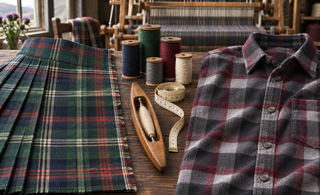
Tartan and plaid are closely related, but they are not always the same thing. In Scotland, tartan usually means the repeating pattern of coloured stripes, while plaid historically meant a length of cloth worn as a garment or wrap. In North America, “plaid” is now the everyday word for many checked patterns—including tartans.
That is why a Scottish kilt may be described as tartan in one shop and plaid in another. The words overlap in modern speech, but understanding the difference helps you identify a named tartan, choose the right kilt, read a fabric listing, and avoid mistaking a generic fashion check for a traditional sett.
Quick answer: Tartan is a repeating design of horizontal and vertical coloured stripes, traditionally specified by a sett and threadcount. Plaid originally referred to a blanket-like Scottish garment, but in modern North American English it often means any crossed-stripe or checked pattern. A named tartan can be called plaid in casual American usage, but not every plaid shirt represents a specific tartan.
Tartan vs Plaid at a Glance
| Feature | Tartan | Plaid |
|---|---|---|
| Traditional Scottish meaning | A repeating pattern of coloured stripes | A length of cloth worn as a wrap, mantle, shawl, or belted garment |
| Modern North American meaning | Usually a named Scottish or tartan-style design | A broad term for crossed stripes and checks |
| Technical identity | Can be defined by its sett and threadcount | May have no recorded name, threadcount, or historical association |
| Common examples | Black Watch, Royal Stewart, Scotland Forever | Flannel shirt checks, buffalo plaid, fashion checks, tartan-style prints |
| Best shopping term for a kilt | Use the exact tartan name whenever possible | Useful as a broad search word, but too vague for precise matching |
What Is Tartan?
The Scottish Register of Tartans defines tartan as a design capable of being woven from two or more alternating coloured stripes that combine vertically and horizontally to create a repeated chequered pattern. The sequence repeats in both directions, producing blocks of solid colour and blended crossing areas.
The complete repeating pattern is called the sett. A sett may be large and dramatic or small and compact. On a traditional kilt, the size of the sett affects apron placement, pleat width, pattern matching, and the amount of cloth needed to make the garment.
A tartan does not have to belong to a clan. Tartans may represent:
- clans and families;
- districts, cities, counties, states, and countries;
- military regiments and pipe bands;
- schools, clubs, charities, and corporations;
- individuals and commemorative events;
- fashion collections and universal designs intended for anyone.
If you are deciding which association matters to you, read our guide on how to choose a tartan for your kilt.
What Is a Tartan Sett?
A sett is one full repeat of the tartan design. Imagine cutting a square section from the cloth at a point where the stripe sequence begins, then continuing until that same sequence starts again. That complete unit is the sett.
Many tartans are symmetrical, meaning the stripe sequence reflects at pivot points like a mirror. Others are asymmetrical and repeat in one continuous direction. Neither form is automatically more traditional or more valuable; the structure simply determines how the pattern is recorded and reproduced.
Sett size matters in tailoring. A six-inch repeat will behave differently from a compact two-inch check when placed across a kilt apron. A skilled maker plans where the pattern sits at the front, how it continues around the wearer, and which colours appear on the pleat faces.
What Is a Tartan Threadcount?
The threadcount is the tartan’s weaving recipe. It records the colour sequence and the number of threads in each stripe. Letters identify colours, while numbers tell the weaver how many threads to use before changing to the next colour.
For example, a simplified sequence might state blue for a certain number of threads, then white, red, black, and green before repeating or reflecting. Change the order or the counts and the proportions of the design change, even if the same colours remain.
This is why the Scottish Register describes threadcount as the “DNA” of a tartan. A small website swatch or photograph may shift because of lighting and screen settings, but the threadcount preserves the design’s underlying geometry.
How Tartan Is Woven
Traditional tartan is formed by crossing warp and weft threads:
- Warp: the lengthwise threads held under tension on the loom.
- Weft: the crosswise threads passed over and under the warp.
The same colour sequence is normally used vertically and horizontally. Where a colour crosses itself, it forms a solid block. Where different colours cross, they blend visually into a half-tone. Traditional 2/2 twill weaving creates the familiar diagonal texture visible when you inspect quality tartan cloth closely.
A tartan can also be printed, painted, or digitally reproduced, but a traditional kilt fabric gains depth from woven colour intersections. The reverse of woven tartan usually carries the pattern as part of the fabric structure, while a surface print may look weaker or less defined on the back.
What Does Plaid Mean?
The older Scottish meaning of plaid is a garment or large piece of cloth rather than a pattern. A plaid could be worn around the shoulders, wrapped as a mantle, used as a blanket, or gathered and belted as part of the great kilt. It might be woven in tartan, but the word described the cloth’s use and form.
In modern North American English, plaid has become a broad pattern category. A plaid shirt may use two or three coloured stripes crossing at right angles, but it may not have a traditional name, a registered threadcount, or any Scottish association. This usage is well established, so calling a flannel shirt “plaid” is not wrong—it is simply a different regional meaning.
Is Every Tartan a Plaid?
The answer depends on which definition of plaid you are using.
- In modern North American usage: a tartan can reasonably be called a type of plaid because it is a crossed-stripe check.
- In traditional Scottish usage: tartan is the pattern, while a plaid is a particular length or garment of cloth. A tartan kilt is not automatically “a plaid.”
For clear international communication, use tartan when naming the pattern and use a specific garment word—kilt, fly plaid, sash, shawl, trousers, or scarf—when describing the item.
Is Every Plaid a Tartan?
No. In modern retail language, plaid can describe many checks that are not named tartans. A fashion designer may arrange crossing stripes for one season without recording a sett or linking it to a clan, district, organisation, or historic design.
A generic plaid may still be attractive and well made. The difference is identity and precision. If a seller claims that a product uses Black Watch, Royal Stewart, Robertson, MacDonald, or another named tartan, the pattern should correspond to that design rather than merely sharing similar colours.
Tartan vs Check: What Is the Difference?
A check is usually a simpler arrangement of regular blocks or repeated bands. Gingham, windowpane, houndstooth, and buffalo check all create grid-like effects, but they do not necessarily follow the same stripe sequence vertically and horizontally or carry a named tartan identity.
The boundary is not absolute. The Scottish Register notes that a check can be treated as a very simple form of tartan, especially when it is capable of being woven and recorded with a threadcount. In everyday shopping, however, these distinctions are useful:
- Tartan: a defined repeating stripe pattern, often named and recorded.
- Plaid: a broad modern term for crossed stripes, particularly in North America.
- Check: usually a simpler grid of regular blocks or bands.
What About Buffalo Plaid, Gingham, and Madras?
Buffalo plaid
Buffalo plaid usually means a bold two-colour block check, most famously red and black. It is common in shirts, jackets, blankets, and seasonal décor. It may technically be capable of being described as a simple tartan-like design, but “buffalo plaid” does not identify a Scottish clan tartan.
Gingham
Gingham uses evenly spaced stripes, commonly in white and one other colour, producing solid, white, and blended squares. Its regular simplicity distinguishes it from the layered overchecks and varied stripe widths found in many tartans.
Madras
Madras is a lightweight cotton cloth associated with South Asia and widely used for colourful summer checks. Its fibre, handwoven tradition, colour palette, and cultural history differ from Scottish wool tartan, even when the surface pattern appears similar.
Windowpane
Windowpane uses thin lines spaced widely over a solid background. It is common in suiting and lacks the dense multi-stripe repeat of a typical tartan.
Why the Difference Matters When Buying a Kilt
A kilt is built around its pattern. The maker must position the front aprons, repeat the sett, and plan the pleats so the design looks intentional from every angle. A vague listing that says only “green plaid kilt” does not tell you enough to predict the finished appearance.
Before buying, check:
- The exact tartan name. This lets you compare the product with reliable references.
- A full-width image. A tiny crop may hide the sett and overchecks.
- Fabric composition and weight. Pattern identity does not tell you whether the cloth is wool, acrylic wool, cotton, polyester, or a blend.
- Yardage. A 5-yard and an 8-yard kilt can display the same tartan with different fullness and pleat depth.
- Pleat alignment. The kilt may be pleated to the sett or to a chosen stripe.
- Made-to-measure details. Waist, seat, drop, and intended wearing position affect the final result.
Browse the current tartan kilts for men to compare named setts across traditional and modern constructions. Women can also explore tartan kilts and skirts in different lengths and silhouettes.
Examples: Black Watch, Royal Stewart, and Scotland Forever
Black Watch
Black Watch uses a dark green, navy, and black palette that works easily with formal jackets, knitwear, boots, and casual shirts. Because the colours are restrained, many first-time buyers find it more versatile than a bright red tartan.
The Black Watch Ancient 8- and 5-yard kilt shows how a named tartan remains identifiable across different yardage options.
Royal Stewart
Royal Stewart is a bold red-based tartan with blue, green, yellow, white, and black lines. Its strong contrast makes it popular for festive outfits and statement pieces. In casual North American conversation, someone may call it “red plaid,” but the exact tartan name communicates far more.
A Royal Stewart tartan utility kilt demonstrates how a traditional named pattern can be adapted into a modern pocketed garment.
Scotland Forever
Scotland Forever is a modern named tartan with a clear design identity. It is a useful example of why tartan is not limited to ancient clan patterns: new designs can be created, recorded, woven, and worn with the same technical discipline.
See the Scotland Forever 8- and 5-yard kilt for a full traditional silhouette.
Does “Ancient” Mean the Tartan Is Older?
Not necessarily. Ancient, modern, muted, weathered, reproduction, dress, and hunting usually describe colour treatments or design variations—not a guarantee of the design’s age.
- Modern: typically stronger, darker, more saturated colours.
- Ancient: softer, lighter tones intended to suggest older natural dyes.
- Weathered or reproduction: earthy, faded-looking colours inspired by aged cloth.
- Muted: subdued shades with lower contrast.
- Dress: often introduces more white for a brighter appearance.
- Hunting: commonly shifts the palette toward green, brown, blue, or other outdoor tones.
A modern-colour version of an old sett and an ancient-colour version of the same sett share the underlying stripe structure while looking noticeably different. Always compare the exact variation named in the product listing.
Does a Tartan Have to Be Registered?
Registration provides an official record of a design, including its name, threadcount, designer, date, category, and stated restrictions. It is especially valuable for new tartans and for checking whether two patterns are genuinely different.
However, registration is not a simple test of historical authenticity. Many well-established tartans predate the modern register, and historical records have been incorporated from earlier databases. A newly registered tartan is not automatically more traditional than an older unregistered textile reference, while an old-sounding name does not prove ancient origin.
Use the official Scottish Register of Tartans to verify a named design, but also read its notes and date rather than judging only by the word “registered.”
What Is a Fly Plaid?
A fly plaid is a square or rectangular piece of tartan worn over the shoulder with formal Highland dress, usually secured with a brooch. Here, plaid is being used in the garment sense: it names the draped cloth, not a generic fashion check.
The fly plaid is normally coordinated with the kilt tartan, although formal traditions and personal styling can vary. It is not required for every wedding or evening outfit and can overwhelm a shorter wearer or a less formal setting. If you plan to use one, follow the fly plaid placement and folding guide.
How Pleating Changes the Look of a Tartan
The front apron usually shows a broad, uninterrupted section of the sett. At the back, the same cloth is folded into pleats. A kilt pleated to the sett aims to continue the overall pattern across the visible pleat faces. A kilt pleated to a stripe centers one selected vertical line on each pleat.
This means two kilts made from the same tartan can have very different rear views. One may reproduce the full sett, while another emphasizes a red, white, yellow, or dark vertical line. Learn more in our guide to knife, box, Kingussie, sett, and stripe pleating.
How to Spot a Misleading Tartan Listing
- The listing says only “Scottish plaid” without naming the design.
- The product photo and stated tartan name do not match.
- Different photos show inconsistent stripe colours or proportions.
- The seller claims every tartan is an ancient clan design.
- No fabric composition, weight, or construction details are provided.
- The image is a digital mock-up that does not show the actual scale of the sett.
- The listing uses “wool” without clarifying whether it is natural wool, acrylic wool, or a blend.
A trustworthy product page should identify the tartan, material, weight, fastening, yardage or construction, length options, and measurement requirements. If the design is made to order, ask for confirmation when colour matching is critical because screens and dye lots can vary.
Which Word Should You Use?
| Situation | Best wording |
|---|---|
| Naming Black Watch or Royal Stewart | Use “tartan” |
| Describing a casual checked flannel shirt in the US | “Plaid shirt” is standard |
| Ordering a specific kilt | Use the exact tartan name and variation |
| Describing a formal shoulder cloth | Use “fly plaid” |
| Describing any simple grid pattern | “Check” may be the clearest term |
| Writing for an international audience | Use “tartan” for the pattern and name the garment separately |
Frequently Asked Questions
What is the simplest difference between tartan and plaid?
Tartan is a defined repeating stripe pattern. Plaid originally meant a Scottish garment or length of cloth, but now often means any crossed-stripe check in North America.
Why do Americans call tartan plaid?
The pattern meaning of plaid became standard in North American English. Because many plaid garments used tartan-like checks, the word expanded from a type of cloth or garment to a broad pattern category.
Is plaid Scottish or American?
The word has Scottish roots, but its common pattern meaning is especially associated with North American usage. Both histories are part of modern English.
Is Black Watch tartan or plaid?
Black Watch is a specific named tartan. In casual American speech it may also be called a plaid pattern, but “Black Watch tartan” is the precise term.
Is Royal Stewart a plaid?
Royal Stewart is a named tartan. A North American retailer may describe it as red plaid, but that broad wording loses the design’s identity.
Can any checked fabric be called tartan?
Not usefully. A simple check may be capable of technical recording, but in shopping and Highland dress the word tartan normally implies a defined repeat or named design rather than any random grid.
Can you wear tartan if you are not Scottish?
Yes. Most tartans are open to general wear, although a small number carry stated restrictions or strong organisational associations. Choose honestly and check the official record when unsure. Read our complete guide on wearing a kilt without Scottish ancestry.
Are kilts always tartan?
No. Traditional Highland kilts are strongly associated with tartan, but modern kilts may be plain wool, cotton, denim, leather, camouflage, or hybrid materials.
Does the tartan pattern continue through kilt pleats?
It can. Pleating to the sett recreates the overall repeat across the visible pleat faces, while pleating to a stripe highlights one selected vertical line.
What should I search when buying a kilt?
Use the exact tartan name plus the garment type, yardage, fabric weight, and size requirements—for example, “Black Watch Ancient 8-yard tartan kilt.”
Final Verdict
Tartan and plaid overlap in modern language, but the distinction is valuable. Tartan is a repeatable pattern with a sett and threadcount; plaid originally named a Scottish cloth or garment and now often describes a broad family of checks in North America. A generic plaid can be stylish, but a named tartan carries a specific design identity that matters when tailoring a kilt.
When shopping, look beyond colour. Confirm the exact tartan, variation, fabric, weight, yardage, pleating, and measurements. Explore the complete Kilt Experts kilt collection to compare traditional tartans with utility, hybrid, leather, and modern designs.