
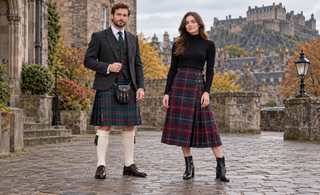
Is a kilt simply a skirt, and is a kilt skirt the same garment as a traditional Scottish kilt? The silhouettes may look related, but the answer becomes clearer when you compare their construction, purpose, fit, length and cultural context.
The distinction matters in 2026 because tartan and pleated skirts are enjoying renewed attention in fashion. Kilt-inspired wrap skirts are appearing in autumn and winter wardrobes, while traditional kilts remain important for weddings, Highland events, formal dress and everyday heritage wear. Knowing the difference helps you search for the right garment, measure correctly and choose a style that suits the occasion.
This guide explains the difference between a kilt and a kilt skirt, answers whether women can wear traditional kilts, and shows how to choose among tartan, utility, leather, mini, midi and long designs.
Quick answer: kilt vs kilt skirt
A traditional kilt is a structured, usually knee-length wrap garment associated with Scottish Highland dress. It normally has overlapping flat aprons at the front, deep permanent pleats at the back, and leather straps or buckles at the waist. Traditional versions are most often made from tartan cloth, although modern kilts may use cotton, denim or leather.
A kilt skirt, also called a kilted skirt, is a fashion garment inspired by the shape and details of a kilt. It may use tartan, wrap construction, side buckles and pleats, but its length, cut, closure, fabric and styling can vary much more widely. Kilt skirts are commonly designed for women and may be mini, knee-length, midi, high-low or full-length.
| Feature | Traditional kilt | Kilt skirt or kilted skirt |
|---|---|---|
| Primary identity | Scottish Highland garment | Fashion garment inspired by kilt construction |
| Typical length | Around the middle of the knee | Mini, knee, midi, high-low or full-length |
| Front | Two overlapping flat aprons | May have an apron, wrap panel, buttons, zip or decorative overlap |
| Back | Deep, carefully arranged pleats | Pleats may be shallow, partial, all-around or purely decorative |
| Fabric | Traditionally tartan wool or a practical wool-blend alternative | Tartan, cotton, leather, denim, tweed or mixed materials |
| Common use | Highland dress, weddings, ceremonies, festivals and heritage wear | Everyday outfits, workwear, street style, alternative fashion and events |
What makes a garment a traditional kilt?
A kilt is defined by more than tartan. Its architecture is what gives it the familiar Highland silhouette. The flat front aprons create a clean front, while the fabric at the sides and back is formed into repeated pleats. On a well-made kilt, those pleats provide swing, weight and structure without making the front bulky.
The garment wraps around the body rather than being pulled on like ordinary trousers. Straps and buckles secure the waist, and many traditional kilts include a small amount of adjustment. The hem generally reaches the middle of the kneecap when the wearer stands naturally. The kilt is normally worn at its intended waist position rather than wherever a pair of modern low-rise jeans happens to sit.
Tartan is the best-known material, but tartan itself is a pattern or cloth rather than a garment. A length of tartan is not automatically a kilt, and a plain or modern utility design can still be a kilt when its structure and purpose support that name. If you want the classic Highland shape, explore traditional tartan kilts for men.
What is a kilt skirt?
A kilt skirt borrows selected visual features from a traditional kilt and adapts them for a broader fashion wardrobe. Common details include a wrap front, side buckles, a tartan pattern and pleats. Designers can then change the length, move the pleats, add a zip or buttons, shape the waistband, introduce a high-low hem, or combine tartan with leather and cotton.
That flexibility is the point. A kilt skirt can look polished with knitwear and boots, relaxed with a T-shirt and loafers, or dramatic with leather and metal hardware. It may reference Scottish heritage closely, or it may use only a few kilt-inspired details.
For a broad view of these options, browse kilts and skirts for women. Shoppers who want the strongest heritage influence can start with women's tartan kilts.
Why kilt skirts are especially relevant in 2026
Heritage checks, tartan, pleated skirts and wrap silhouettes have all received strong fashion attention in 2026. The appeal is practical as well as visual: one structured skirt can create a complete outfit when paired with a simple knit, shirt, blazer or boots. Tartan provides colour and pattern, while the pleats add movement.
The current look is less about copying ceremonial Highland dress and more about combining heritage details with everyday clothing. Midi lengths, fitted knitwear, oversized coats, knee-high boots and modern leather accessories make a kilt skirt feel contemporary. At the same time, customers who want authentic Highland proportions can still choose a traditionally constructed kilt.
This creates a useful SEO and shopping distinction: people searching for a “women's kilt,” “tartan kilt skirt,” “pleated tartan midi skirt” or “Scottish skirt” may be looking for different garments. Product construction and measurements matter more than the label alone.
Seven important differences between a kilt and a kilt skirt
1. Cultural purpose
A traditional kilt has a defined place in Scottish Highland dress. It may express family, district, organisational or personal connections through tartan, and it is commonly worn at weddings, ceilidhs, Highland games, parades and formal events.
A kilt skirt is primarily a fashion garment. It can still honour Scottish design and tartan tradition, but it is not automatically part of a complete Highland outfit.
2. Construction
Traditional kilts use a flat front and a carefully pleated back. The amount of fabric, depth of pleats and way the sett is arranged all affect the finished look. Kilt skirts have more freedom: some are fully pleated, some use pleats only on one side, and others combine an apron front with an A-line or midi-skirt shape.
3. Length
A traditional kilt is normally designed to finish around the middle of the knee. A kilt skirt may be much shorter or longer. The Women's Tartan Pleated Midi Kilt, for example, offers the movement of pleats in a longer fashion silhouette. A Women's Long Plaid Skirt creates a still more extended line, while a mini version gives a youthful casual look.
4. Fit and waist position
Traditional kilts need accurate waist, hip and drop measurements because their balance depends on where they sit and where the hem falls. Kilt skirts may sit at the natural waist or slightly lower, depending on the pattern. Some have a shaped waistband, elastic section, zip, buttons or wider adjustment range.
Never assume that a trouser size is the same as a kilt measurement. Use a soft tape and follow the garment's individual instructions. Our kilt measurement guide explains the waist, hip and length process step by step.
5. Fabric and weight
Traditional tartan kilts rely on a fabric substantial enough to hold pleats and drape properly. Kilt skirts can use heavy tartan, lighter cloth, cotton, leather or mixed materials. The Dundee Old Ancient Tartan High-Low Skirt combines a 16 oz tartan look with a modern hemline.
Fabric changes how the garment moves. A heavier tartan looks structured, cotton feels practical and casual, and leather produces a sharper alternative-fashion effect.
6. Fastenings and functional details
A classic kilt usually uses leather straps and buckles. Fashion kilt skirts may add zippers, buttons, Velcro, decorative straps or elastic. Utility designs can also introduce detachable pockets, D-rings and contrast panels. The Newly Hybrid Women's Utility Kilt is a good example of a design built around everyday function rather than formal Highland rules.
7. Styling and accessories
A traditional kilt can be completed with kilt hose, flashes, brogues, a sporran, belt and an appropriate jacket. A kilt skirt does not require that full system. It can be styled like another structured skirt, using a blouse, sweater, blazer, tights, boots or minimal jewellery.
A kilt pin is functional decoration for the outer apron of a traditional kilt; it should not pin all layers together. Read our kilt pin placement guide before attaching one. On a fashion skirt, follow the specific garment construction and avoid puncturing leather or delicate fabric unnecessarily.
Is a kilt a skirt?
In the broad clothing sense, both are non-bifurcated lower-body garments. That technical similarity is why dictionaries and general fashion discussions may describe a kilt as skirt-like. In cultural and tailoring terms, however, “kilt” is the more accurate name for the traditional Scottish garment.
Calling every pleated tartan skirt a kilt ignores differences in construction. Calling a traditional Highland kilt merely a skirt can also miss its history, conventions and significance. The clearest approach is simple: use “kilt” for a garment built and worn as a kilt, and “kilt skirt” or “kilted skirt” for a fashion adaptation.
Can women wear traditional kilts?
Yes. Women can wear traditional kilts, modern kilts and kilt skirts. There is no practical rule that limits tartan or kilt construction to one gender. The better question is which cut, length and purpose the wearer prefers.
A woman taking part in piping, Highland events or a coordinated wedding party may choose a traditionally proportioned kilt. Someone building an everyday wardrobe may prefer a shaped kilt skirt or midi length. A customer who needs pockets and freedom of movement may choose a utility kilt, while a leather design suits a stronger contemporary or alternative look.
For a classic compact option, consider a Women's Black Watch Tartan Kilt. For a bolder finish, compare the women's leather kilt collection with the women's utility kilt collection.
Which style should you choose?
Choose a traditional tartan kilt if:
- You want recognisable Highland proportions and construction.
- You are dressing for a wedding, ceilidh, parade, clan gathering or formal Scottish event.
- You prefer a knee-length garment with a flat apron and deep back pleats.
- You want to coordinate a sporran, hose, flashes and kilt jacket.
Choose a tartan kilt skirt if:
- You want tartan and pleats in an everyday fashion silhouette.
- You prefer a mini, midi, high-low or full-length option.
- You plan to wear the garment with knitwear, blouses, blazers, tights or fashion boots.
- You want a shaped waistband or a closure such as a zip or buttons.
Choose a utility kilt if:
- Pockets, movement and durability are priorities.
- You prefer cotton or mixed-material construction.
- Your wardrobe leans casual, workwear, festival or alternative.
Choose a leather kilt or skirt if:
- You want a strong modern silhouette and substantial texture.
- You like gothic, punk, rock or fashion-forward styling.
- You are prepared to follow leather-specific cleaning and conditioning instructions.
A useful rule is to choose by purpose first, then length, fabric and tartan. The garment should fit the event and your wardrobe rather than simply matching a search term.
How should a kilt or kilt skirt fit?
The waistband should feel secure without digging in, and the garment should remain level around the body. Pleats should hang vertically rather than pulling open across the hips. On a traditional kilt, the front aprons should overlap cleanly and the hem should fall near the middle of the knee. On a kilt skirt, the intended design determines the hem, but the wrap or closure should still lie flat.
When ordering, measure over the clothing you expect to wear underneath. Keep the tape level and comfortably firm. Do not pull in the stomach, add unrequested allowance or rely on a favourite pair of jeans. If the product is custom made, accurate measurements are especially important because custom garments may have different return conditions.
How to style a kilt skirt without making it look like a costume
Let one heritage element lead the outfit. If the skirt is a colourful tartan, keep the top, coat and footwear relatively simple. Black, charcoal, cream, navy and brown are dependable partners. Repeat one quieter colour from the tartan rather than matching every stripe.
- Everyday: tartan midi kilt skirt, fitted knit, ankle boots and a plain coat.
- Office: knee or midi length, crisp shirt, tailored blazer and loafers.
- Weekend: mini or utility kilt, T-shirt, denim or leather jacket and sturdy boots.
- Evening: dark tartan or leather, simple fitted top, polished boots and restrained metal accessories.
- Heritage event: traditional kilt or kilted skirt with a blouse, sash, jacket or coordinated tartan detail.
For colder-weather combinations, see our guide to styling a tartan kilt for fall and winter 2026.
Common buying mistakes to avoid
- Choosing by label alone: inspect the length, pleat placement, fabric and closure.
- Using trouser size: take actual body measurements at the garment's intended waist position.
- Assuming all tartan is wool: read the material specification for each product.
- Ignoring movement: deep pleats, shallow pleats, leather and cotton all behave differently.
- Over-accessorising: fashion kilt skirts rarely need every component of formal Highland dress.
- Buying the wrong length for the occasion: a mini, midi and traditional knee-length kilt create very different impressions.
- Skipping care instructions: tartan, cotton and leather require different cleaning methods. Use our kilt cleaning and storage guide as a starting point.
Frequently asked questions
What is a women's kilt called?
Common names include women's kilt, ladies' kilt, kilt skirt, kilted skirt and tartan skirt. The construction is more informative than the name: check whether it follows traditional kilt proportions or uses a fashion-skirt pattern.
What is the main difference between a kilt and a kilt skirt?
A traditional kilt follows a recognisable Highland structure with overlapping front aprons, deep back pleats and a knee-length fit. A kilt skirt adapts some of those features into a wider range of lengths, fabrics and fashion cuts.
Can men wear kilt skirts?
Anyone can choose clothing according to fit and preference. A shopper who wants traditional Highland dress should choose a properly constructed kilt; someone seeking a fashion silhouette can choose a skirt or contemporary kilt design that fits their measurements.
Do kilt skirts have to be tartan?
No. Tartan is common, but kilt skirts may be made from plain wool, cotton, denim, leather or mixed fabrics. Wrap construction, pleats and buckle details can communicate the kilt influence without tartan.
Is a plaid skirt the same as a tartan kilt skirt?
Not always. “Plaid” is often used broadly for checked patterns, especially in North America. A tartan kilt skirt combines a tartan or tartan-like pattern with kilt-inspired construction, while a plaid skirt may use any ordinary skirt pattern.
Should a traditional kilt cover the knee?
The conventional hem sits around the middle of the kneecap when standing. Personal preference and activity can affect length, but a much shorter or longer garment moves away from the standard traditional proportion.
Can I wear a sporran with a kilt skirt?
You can, particularly for a heritage event or when the garment lacks pockets. For ordinary fashion styling, a handbag, crossbody bag or built-in pocket may look more natural.
Are kilt skirts only for fall and winter?
No. Heavier tartan suits cold weather, but lighter fabrics and shorter cuts can work in spring and summer. The season should guide fabric weight, layering and footwear rather than decide whether the style can be worn.
Final verdict
A traditional kilt and a kilt skirt share a visual family, but they are not interchangeable terms. The kilt is a specific Highland garment shaped by established construction and cultural use. The kilt skirt is a flexible fashion interpretation that can be shorter, longer, lighter, more fitted or more experimental.
Choose the traditional kilt when authenticity, formal Highland styling and classic proportions matter most. Choose the kilt skirt when you want tartan, pleats and wrap details in an adaptable everyday silhouette. Whichever direction suits you, accurate measurements and attention to fabric will make a bigger difference than the product name alone.
Explore the complete women's kilt and skirt collection or browse kilt accessories to finish your look.