
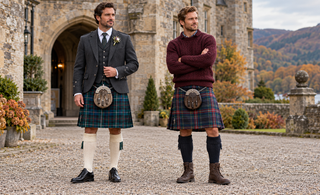
What do you wear under a kilt? It is one of the most searched, joked-about and misunderstood questions in Highland dress. The practical answer is simple: wear the undergarment that keeps you comfortable, hygienic, secure and appropriate for the occasion. Modern kilt wearers commonly choose fitted boxer briefs, trunks, athletic compression shorts or a thermal base layer. Some adults choose to wear nothing underneath—a practice often called “going regimental”—but it is a personal choice, not a test of Scottish authenticity.
The best option depends on whether you are attending a wedding, dancing at a ceilidh, competing at Highland games, working outdoors, wearing a rental, or simply trying a kilt for the first time. This guide explains the tradition, the most practical choices and the etiquette that helps you wear a kilt confidently.
Quick answer: what should you wear under a kilt?
For most people and most occasions, clean, close-fitting underwear is the safest all-around choice. It provides coverage when sitting, climbing stairs, dancing or dealing with wind. It can also reduce friction and help protect the kilt from perspiration.
- Formal wedding or dinner: fitted boxer briefs or trunks.
- Ceilidh or dancing: supportive boxer briefs or discreet compression shorts.
- Highland games or active events: athletic compression shorts that meet event rules.
- Cold weather: thermal shorts or a thin base layer that does not show below the hem.
- Hot weather: breathable, moisture-wicking underwear.
- Rental kilt: always wear clean underwear as a matter of hygiene and courtesy.
- Casual personal wear: choose the option that makes you comfortable and keeps the outfit appropriate in public.
There is no universal rule requiring a civilian wearer to go without underwear. You do not become more or less Scottish because of what you choose beneath the kilt.
What does “going regimental” mean?
“Going regimental” is the common expression for wearing a kilt without underwear. The phrase is associated with stories and practices from Scottish military life, where uniform traditions varied by regiment, period and circumstance. Over time, the idea became part of popular culture and generated far more curiosity than almost any other aspect of kilt etiquette.
It is important not to turn that history into a false modern rule. Military uniform customs do not automatically govern weddings, festivals, workplaces, rental garments or daily civilian wear. Contemporary kilt wearers make their own decision based on comfort, hygiene, activity and setting.
The phrase “true Scotsman” is often used jokingly, but clothing beneath a kilt is not a measure of ancestry, respect or cultural knowledge. Wearing the kilt correctly—with a suitable fit, length and attitude—matters far more.
Do Scottish men really wear nothing under a kilt?
Some do, and many do not. There is no single answer that applies to every Scottish man or every kilt wearer. Personal preference, family tradition, military background, weather, activity and the formality of the event can all affect the choice.
The popular image of every Scotsman wearing a kilt “traditionally” without underwear is an oversimplification. A person walking through a windy city, dancing for hours, working at a festival or wearing a hired outfit may reasonably prioritize secure coverage. Another adult wearing a privately owned kilt in a controlled setting may make a different choice.
Respectful etiquette means not asking someone to prove what they are wearing underneath and never attempting to lift, photograph or interfere with another person's kilt.
The best underwear options for wearing a kilt
1. Fitted boxer briefs
Fitted boxer briefs are the most versatile option for first-time and experienced wearers. They provide coverage and support without creating excessive fabric beneath the apron or pleats. A smooth, close fit also reduces the chance of material bunching around the hips.
Choose a breathable fabric and a leg length that remains well above the kilt hem. Dark or neutral colours are less likely to draw attention if the garment becomes briefly visible during movement.
2. Trunks
Trunks are shorter than many boxer briefs and work well when you want support without fabric extending far down the thigh. They are useful with a traditionally knee-length kilt and can be comfortable for weddings, dinners and ordinary social events.
3. Athletic compression shorts
Compression shorts are a sensible choice for Highland games, energetic dancing, marching, hiking or long outdoor events. They stay in place, reduce chafing and provide dependable coverage during large movements. Select a length and colour that remain discreet beneath the kilt, and follow the rules of any organised competition or performance.
4. Moisture-wicking performance underwear
For hot weather or long festival days, lightweight performance underwear can manage moisture better than heavy cotton. Look for flat seams, a supportive cut and fabric that dries quickly. Comfort becomes especially important when the kilt is made from a substantial material.
5. Thermal shorts or a thin base layer
Cold conditions do not require abandoning the kilt. Thin thermal shorts can add warmth without changing the visible outfit. The layer should finish high enough to remain concealed and should not add so much bulk that the waistband becomes tight.
Warmth should also come from the rest of the outfit: jacket, waistcoat, coat, kilt hose and weather-appropriate footwear. Our guide to styling a tartan kilt for fall and winter explains how to layer without hiding the garment.
6. Loose boxer shorts
Loose boxers are possible, but they are usually less practical. Excess fabric can bunch at the seat, disturb the fall of the kilt or become visible during movement. If you prefer boxers, choose a short, lightweight pair and confirm that the kilt still hangs cleanly.
What should you wear under a kilt at a wedding?
For a wedding, clean fitted underwear is the most reliable choice. Wedding days involve sitting through a ceremony, walking, photographs, stairs and often energetic dancing. Coverage lets you focus on the event instead of repeatedly checking the kilt.
Boxer briefs or trunks in a dark neutral colour work for most grooms, groomsmen and guests. Compression shorts may be useful for a lively ceilidh, but avoid long sports shorts that appear beneath the hem. If the wedding outfit is hired, underwear should be treated as essential.
The outer outfit should be planned just as carefully. A complete set may include a properly measured kilt, shirt, waistcoat, jacket, hose, flashes, brogues and sporran. Browse complete kilt outfit deals, including the Complete Outfit Wedding Kilt Deal, for coordinated options.
What should you wear under a kilt for Highland games?
Highland games involve bending, lifting, turning and explosive movement. Modesty and support are more important than a joke about tradition. Competitors often need athletic undergarments, and organisers may have specific rules. When in doubt, ask the event or team before competing.
Close-fitting compression shorts are usually the most practical option. They reduce friction and stay secure during caber, stone, hammer or weight events. Avoid loose garments that restrict movement or extend below the kilt.
For spectators, the demands are lower, but outdoor conditions still matter. Wind, uneven ground and long periods of sitting make supportive underwear the easy choice.
What about a utility or modern kilt?
Utility kilts are designed for movement, pockets and everyday use, so practical underwear normally makes sense. Work, hiking, festivals and active travel all involve situations where secure coverage is useful. Breathable boxer briefs or performance trunks pair well with cotton utility designs.
Explore utility kilts for men if you need functional pockets and a modern silhouette. The Black Deluxe Utility Fashion Kilt is one example of a substantial cotton style suited to contemporary wear.
Pockets, straps and heavier hardware do not replace proper fit. Make sure the waist is secure and the hem is suitable for your height before using a utility kilt for active work.
What should you wear under a leather kilt?
Leather is less breathable than many tartan or cotton fabrics, so a moisture-wicking underlayer can improve comfort. Smooth trunks or boxer briefs help reduce direct friction and can protect the inside of the garment from perspiration.
Avoid bulky seams and thick layers that create visible ridges beneath fitted leather panels. Never apply talcum powder, deodorant spray or cleaning chemicals directly to the leather lining unless the product's care instructions specifically permit it. Browse leather kilts for men and check the individual construction before choosing an underlayer.
Do women wear anything under kilts and kilt skirts?
Women can wear traditional kilts, modern kilts and kilt skirts, and the same principle applies: choose an undergarment appropriate to the garment, activity and setting. Seamless briefs, fitted shorts or anti-chafing shorts can work beneath mini, knee-length or midi styles. Tights or thermal tights may be useful in cold weather.
The right choice depends on the hemline and movement of the design. A long tartan skirt needs a different solution from a short utility kilt. Browse kilts and skirts for women and use the measurements and product photos for the specific design.
Rental-kilt etiquette
If you are wearing a rented kilt, use clean underwear. This is basic courtesy to the next wearer and the rental company. Kilts are structured garments that are not washed like a T-shirt after every use, so protecting the interior matters.
- Wear fresh underwear throughout the event.
- Do not place adhesive products directly on the kilt.
- Follow the rental company's written rules.
- Return every accessory in the condition in which it was received.
- Report spills or damage instead of attempting an aggressive home clean.
For privately owned garments, the same habits can reduce how often the kilt needs a full clean. Read our kilt cleaning and storage guide for fabric-specific care.
How kilt fit affects comfort and privacy
The question of what is underneath often distracts from the more important issue: whether the kilt fits correctly. A properly measured kilt sits securely at its intended waist position, overlaps cleanly at the front and reaches approximately the middle of the knee in a traditional cut.
If the waist is too loose, the kilt can rotate or drop. If the seat and hips are too tight, the pleats may pull open instead of hanging vertically. An excessively short hem increases exposure risk, while an overly long one changes the traditional proportion and may restrict movement.
Do not order from your jeans label alone. Measure the actual waist at the position where the kilt will sit, the fullest part of the hips and the required drop. Follow our detailed waist, hip and kilt-length guide before ordering.
For a classic structured option, browse tartan kilts for men or consider the Royal Stewart 8-Yard 16 oz Heavy Tartan Kilt.
Does a sporran keep a kilt from blowing up?
A sporran adds some weight to the front apron and gives the wearer practical storage, but it is not a complete privacy device. Wind can affect the sides or back, and energetic movement can lift fabric in other directions.
Wear the sporran at a comfortable height centred on the front, unless the activity requires moving it to the side. Choose a style that suits the occasion from the sporran collection. For strong wind or active events, fitted underwear remains the dependable precaution.
Does a kilt pin hold the kilt closed?
No. A kilt pin is normally attached through the outer apron only. It adds decorative weight and helps the outer corner hang neatly, but pinning both aprons together can restrict movement and strain or tear the fabric.
The straps and buckles secure the garment. Place the pin correctly and do not use an oversized, heavy piece as a substitute for good fit. See our kilt pin placement guide for the correct position.
Practical tips for sitting, stairs, wind and dancing
Sitting
Smooth the pleats beneath you as you sit so they do not fold awkwardly. Keep your knees in a comfortable, appropriate position and check that the apron remains flat. A chair is generally easier than a very low sofa.
Climbing stairs
Take a natural stride without grabbing or lifting the hem. If you are carrying a bag or coat, keep one hand free for balance. Well-fitted underwear provides reassurance on open or crowded staircases.
Wind
Face into strong wind when possible and use a coat outdoors in severe conditions. The sporran and kilt pin can steady the front, but neither controls every pleat. Avoid holding all the fabric tightly against the body for long periods because that can crease the apron.
Dancing
Ceilidh dancing creates movement and spin. Secure buckles before the event, keep the sporran positioned comfortably and choose supportive underwear. Practice a few steps before leaving home if this is your first time wearing the full outfit.
Common mistakes to avoid
- Believing underwear is disrespectful: it is a personal, practical choice.
- Treating “going regimental” as compulsory: a historical association is not a universal civilian dress code.
- Wearing visible long shorts: choose a shorter underlayer or adjust the kilt length.
- Ignoring the activity: dancing and athletics require more support than standing at a formal reception.
- Going without underwear in a rental: this is poor hygiene and may violate rental terms.
- Using the kilt pin as a safety pin: it belongs on the outer apron, not through every layer.
- Relying on the sporran alone: it steadies the front but cannot prevent every exposure.
- Ordering an overly short kilt: accurate length is central to both appearance and confidence.
- Asking strangers what they are wearing underneath: treat the question as private unless the wearer chooses to discuss it.
Frequently asked questions
Is it traditional to wear nothing under a kilt?
The practice has associations with military and popular tradition, but it has never meant that every kilt wearer must do the same. Modern civilian wearers choose according to comfort, hygiene and occasion.
Is it disrespectful to wear underwear under a kilt?
No. Wearing underwear is not disrespectful and does not make the outfit less authentic. Correct fit, appropriate styling and respectful behaviour matter more.
Can I wear shorts under a kilt?
Yes, but fitted compression shorts are generally better than loose gym shorts. Make sure they do not show below the hem or distort the way the kilt hangs.
What colour underwear is best under a kilt?
Dark neutral colours are discreet. The fit and length matter more than the colour, but bright prints may attract unwanted attention if briefly visible during activity.
Should a groom wear underwear under his kilt?
Fitted boxer briefs or trunks are the sensible choice for most grooms. A wedding involves sitting, photographs, stairs and dancing, and secure coverage removes an unnecessary worry.
Do you wear underwear with a kilt at Highland games?
Competitors should wear the supportive undergarment required or permitted by the event. Compression shorts are practical for athletic movement. Confirm the organiser's rules rather than assuming.
Can I wear leggings under a kilt?
You can for warmth, casual styling or specific activities, but visible leggings are not part of standard formal Highland dress. For a traditional formal outfit, use a concealed thermal layer and proper kilt hose.
What is worn over the front of a kilt?
A sporran is worn at the front because traditional kilts do not have trouser-style pockets. It carries small essentials and visually completes many Highland outfits.
How do I stop a kilt from blowing up?
Start with the correct fit and length. Wear fitted underwear, position the sporran correctly, attach the kilt pin to the outer apron and use a coat in severe wind. No accessory can eliminate all movement.
What else do I need with a kilt?
The answer depends on the occasion. A casual outfit may need only a shirt, kilt and boots; formal Highland dress can include a jacket, waistcoat, hose, flashes, brogues, sporran, belt and tie. Read our complete guide to what to wear with a kilt and browse kilt accessories.
Final verdict
What you wear under a kilt is a private decision, but there is no mystery about the most practical advice. Clean, close-fitting underwear works best for most weddings, rentals, festivals, travel and active events. Compression shorts are useful for sport and dancing, moisture-wicking fabrics help in heat, and a discreet thermal layer adds warmth in winter.
Going regimental remains an adult personal choice where the setting, rules and ownership of the garment make it appropriate. It is not a requirement, and nobody should be pressured to prove anything about what is beneath their kilt.
Choose comfort, hygiene and confidence; then focus on the details everyone can see: accurate measurements, a well-made kilt and accessories suited to the occasion. Explore the full kilt collection at Kilt Experts to build an outfit that feels as good as it looks.